On August 14, 2026, Diana Harshbarger put out a statement celebrating a federal rule that takes health coverage away from poor children.
She did not describe it that way. She described it as protecting kids. But that is what the rule does, and it is worth being precise about who it reaches.
What she was celebrating
The Centers for Medicare & Medicaid Services finalized a rule barring state Medicaid plans and the Children's Health Insurance Program from covering puberty blockers, hormones or surgery for minors — and barring federal dollars from paying for any of it. It takes effect October 13, 2026, with a tapering-off period of up to six months for children already on hormone therapy.
Medicaid and CHIP are the coverage of last resort. They exist for families who cannot pay for care any other way. So the children this rule reaches are, by definition, the poorest ones — kids whose doctor, parents and therapist agreed on a treatment plan that is now going to stop because of a rule written in Washington.
Harshbarger's reaction:
"I am grateful CMS is finally cutting off every taxpayer dollar that funded this abuse, and I will not rest until Congress passes my STOP Act and TRUTH in Coverage Act so this industry can never prey on another child again."
That last clause is the news. She is telling you the rule is not the finish line.
What "I will not rest" means in bill text
Harshbarger has two bills, and they are considerably more aggressive than a Medicaid coverage rule.
The STOP Act — Safeguarding the Overall Protection of Minors — which she introduced in April alongside Sen. Roger Marshall of Kansas, would:
- Ban gender transition procedures on minors outright, not just decline to pay for them
- Impose civil penalties of at least $100,000 per violation, collectible by the Attorney General
- Create a private right of action so patients or their families can sue doctors for damages in federal court
- Route the penalty money into a "Victims of Gender Transition Procedures Compensation Fund" in the U.S. Treasury
The TRUTH in Coverage Act, introduced in July, requires insurers that cover this care to also cover "restorative care" on the same terms.
Read the STOP Act's structure again. A $100,000-minimum federal penalty plus an open invitation to sue is not a coverage policy. It is a mechanism designed to make it too legally dangerous for any doctor in the country to provide this care to a minor — including in states where it is legal, and including for families paying entirely out of pocket.
The CMS rule takes away the money. Harshbarger's bill takes away the option.
The medical consensus she is legislating against
Harshbarger is a pharmacist by training. Her statement rests on an HHS report titled "Wolves in White Coats," which alleges hospitals billed nearly $120 million for care on minors since 2019 — including nearly $50 million in puberty-blocker claims it says were filed under vague or inaccurate diagnosis codes. Those are the administration's own findings, produced by the same administration that then referred hospitals to the Justice Department and to HHS's own inspector general — not an independent audit.
Set against that: the American Academy of Pediatrics' policy statement, "Ensuring Comprehensive Care and Support for Transgender and Gender-Diverse Children and Adolescents," recommends "providing youth with access to comprehensive gender-affirming and developmentally appropriate health care," supporting insurance coverage for those interventions where appropriate, and having pediatricians advocate for policies that "promote acceptance of all children."
That is the professional body of American pediatricians. Harshbarger's bill would fine its members $100,000 a time for following its guidance.
The Texas piece she left out
Harshbarger's release points to Texas Children's Hospital, which paid a $10 million settlement with the Texas Attorney General and the Justice Department over fraud allegations, and agreed to open the nation's first "Detransition Clinic."
Here is what the release doesn't mention. That settlement was Ken Paxton's, and part of the deal permanently stripped three doctors of their hospital privileges and barred two former ones for life. A Stanford pediatrician described the result as a clinic built by legal intimidation — a facility ordered into existence by a prosecutor, with the physicians who understood the underlying medicine barred from working in it.
Cited as a success story, it is really a preview of the STOP Act's enforcement model.
This is not a one-off for her
Harshbarger's interest in this subject has not always arrived in the language of patient safety.
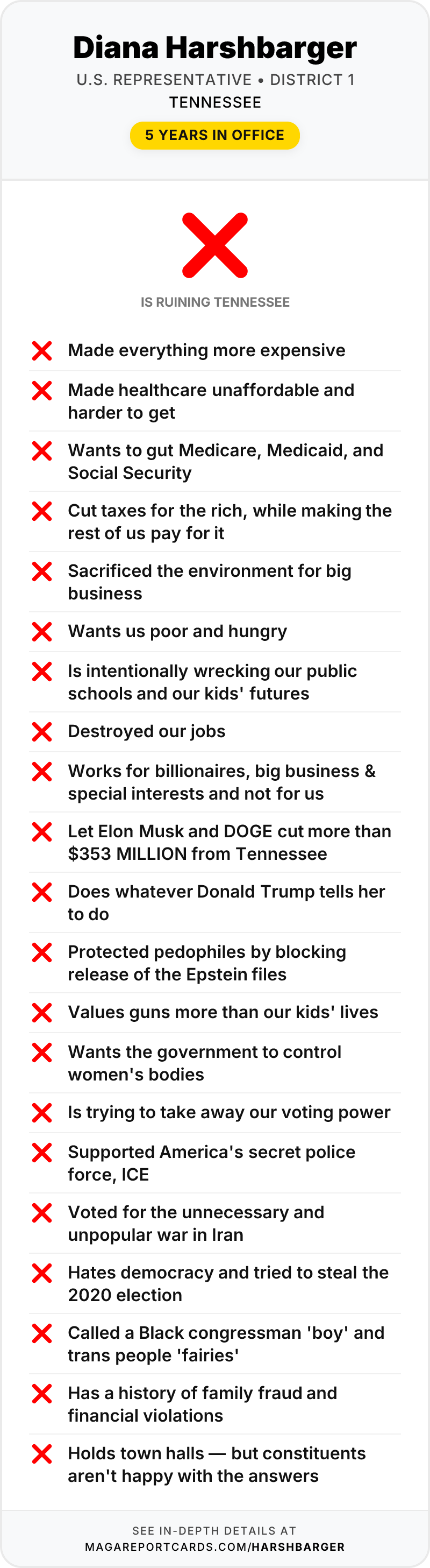
In an interview, she said of the Biden White House, "I never saw so many fairies in the White House, dancing around." In the same interview she called a 77-year-old Black congressman "boy" — and when he explained why that word is a slur, she tweeted "BOY oh boy."
A year later she was writing federal legislation about transgender people.
She also signed on as a cosponsor of the SAFE KIDS Act, which would void surrogacy contracts based on the nationality of the intended parents — part of the same broader push against the ways LGBTQ families and infertile couples actually have children.
What this costs in Tennessee's 1st District
Tennessee already bans this care for minors. Its law was the one the Supreme Court upheld 6–3 on June 18, 2025 in United States v. Skrmetti, ruling it classifies by age and medical diagnosis rather than sex. As KFF counted at the time, 25 states' bans were left standing.
So the practical effect on Harshbarger's own constituents is narrower than the rhetoric implies. The care is already unavailable to them.
What her bills would do is reach past Tennessee. A $100,000 federal penalty and a private right of action apply in Illinois and California and Massachusetts too. That is the point of writing it as federal law rather than state law.
Harshbarger is not asking for the ability to set policy for her district. She has that. She is asking to set it for everyone else's.
Source
Rep. Diana Harshbarger's office: "Harshbarger Applauds Recent HHS Crackdown on Sex-Rejecting Procedures for Children," August 14, 2026.