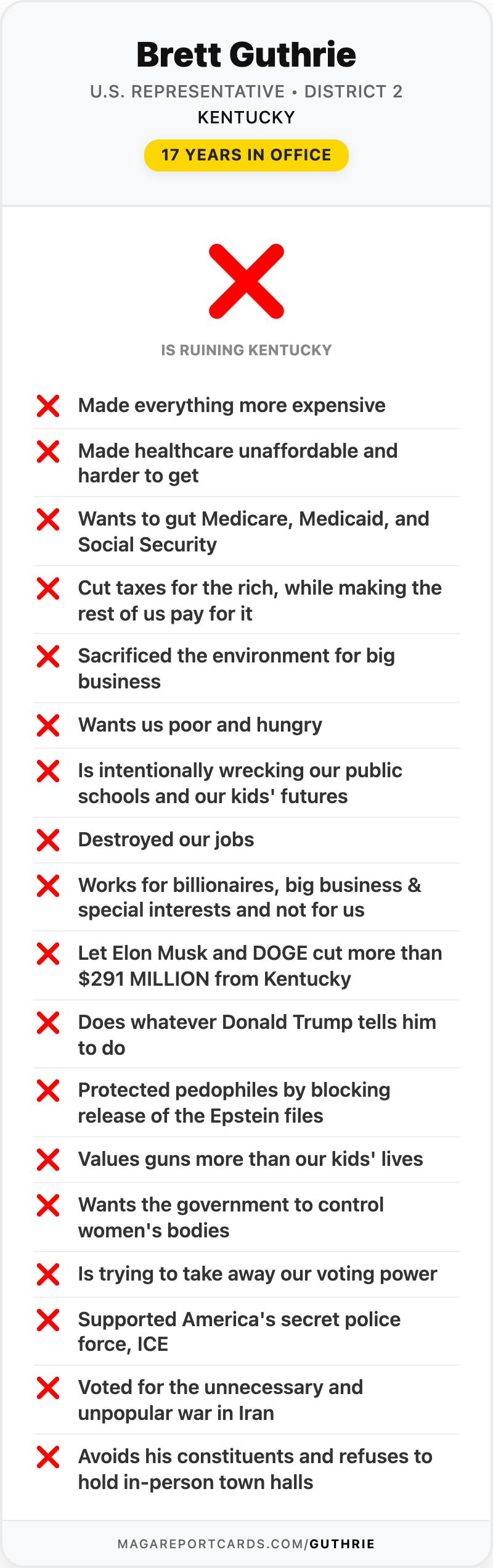
On July 1, a big chunk of Trump's "One Big Beautiful Bill" kicked in for student loan borrowers. The Biden-era SAVE plan — the most generous repayment plan, which more than 7 million people were using — is gone. Graduate students, who used to be able to borrow what their program actually cost, are now capped at $20,500 a year and $100,000 total. Parents are capped too. And the new Republican-designed repayment plan, called RAP, doesn't forgive anything left over until you've been paying for 30 years.
More than 600,000 Kentuckians carry student loan debt. Brett Guthrie voted for that bill on July 3, 2025.
So this is a good moment to look at what Guthrie actually believes about people getting help with debt. Because his record is very clear — and it depends entirely on who is asking.
"A bribe to score political points"
In August 2022, President Biden announced a plan to cancel some federal student loan debt. Guthrie was not happy. He tweeted that it was:
"President Biden's taxpayer-funded student loan debt cancellation plan is a bribe to score political points ahead of the election at the expense of Americans who decided to pursue careers that didn't require taking on student debt or who worked hard to pay off their debt already."
That's the argument. Debt forgiveness is a handout. It's unfair to the people who paid their own way. It's taxpayers footing the bill for someone else's choices.
Remember that argument. He was about to fail his own test.
$4,367,200 in — $4,416,574 out
Guthrie is a director of Trace Die Cast, a Bowling Green auto-parts manufacturer where, as his own campaign site puts it, he "worked as Vice-President." In April 2020, Trace Die Cast got a federal Paycheck Protection Program loan for $4,367,200. Every dollar of it was forgiven — $4,416,574 once you count the interest, according to Small Business Administration records published by ProPublica.
That is taxpayer money. It was a loan. It was cancelled. Nobody paid it back.
And Guthrie isn't a bystander at that company. Back in 2020, the news site Sludge reported that his stake in Trace Die Cast was worth between $500,001 and $1 million, with up to another $5 million held through a family trust — enough to put him in the top 40 richest members of Congress.
Kentucky Democrats did the math and put it next to his tweet: $4.3 million is roughly four years of tuition for about 97 Western Kentucky University students. WKU is in Bowling Green. It's in his district. Those are his constituents.
LEX 18 asked Guthrie about it. He didn't respond.
Here's the thing. You can believe PPP was good policy — a lot of people do, and it kept workers employed during a pandemic. But you cannot believe PPP was good policy and that student loan forgiveness is "a bribe." Both are the federal government cancelling a debt. One helped a nurse who owes $40,000. The other helped a company that made a man in Congress richer.
Guthrie picked the one that helped him.
He didn't just vote against forgiveness. He wrote the bill to kill it.
This isn't a one-time slip. In 2017, Guthrie was chairman of the House Subcommittee on Higher Education and Workforce Development. He and Chairwoman Virginia Foxx introduced a 542-page rewrite of federal higher education law called the PROSPER Act. Guthrie was its sole original cosponsor.
Buried in those 542 pages: the elimination of Public Service Loan Forgiveness for anyone new to the program, and the end of loan forgiveness after 20 or 25 years of income-based payments.
Public Service Loan Forgiveness is the deal we offer teachers, nurses, firefighters, police officers, and social workers: work full-time in public service for 10 years, make 120 payments, and we'll wipe out what's left. It is the single biggest reason a lot of people can afford to take a public school teaching job in a rural county instead of a corporate job in a city.
Guthrie wanted it gone. And he said so proudly. At the December 12, 2017 markup, he opened with this:
"I am proud to be a cosponsor of the PROSPER Act, and truly believe the measures within this bill are essential to improve access, completion, and accountability across the higher education system."
The PROSPER Act never became law. But that wasn't for lack of effort on Guthrie's part — and eight years later, the bill he did pass got a lot of the way there anyway.
The rules he voted for are the rules Kentucky lives under now
Guthrie's yes vote on the One Big Beautiful Bill is what produced the changes that landed on July 1:
- SAVE is dead. Millions of borrowers who had a payment they could afford now get moved onto plans that cost more. Financial aid experts warned NPR this could make a rising wave of student loan defaults worse — a lot of people were on SAVE precisely because their income was low enough to qualify for a $0 payment.
- Grad school borrowing is capped at $20,500 a year and $100,000 total, which advocates warn could eventually mean a shortage of nurses and other health care providers.
- The new RAP plan makes you wait 30 years for forgiveness, up from 20 or 25.
- Parent PLUS borrowers who take out a loan after July 1 can no longer use any income-based plan, and no longer qualify for Public Service Loan Forgiveness at all.
That last one deserves a second read. Guthrie tried to abolish PSLF outright in 2017. He didn't get it. So he voted for a bill that quietly shuts a whole category of borrowers out of it instead.
Meanwhile, the same bill Guthrie helped move — he chairs the powerful Energy and Commerce Committee, which handled its Medicaid cuts — is the one Kentucky's own hospitals called "devastating". He called it a victory.
One more thing about who paid for whose education
Guthrie graduated from West Point in 1987. Tuition at West Point is free. Room, board, and medical care are free. Cadets get a salary. The academy puts the value of that four-year education at more than $250,000, and it is paid for entirely by American taxpayers. In exchange, graduates serve — five years on active duty, three more in the reserves. Guthrie served as a field artillery officer in the 101st Airborne.
He earned that. Nobody should take it from him.
But notice what it is. It is an education fully funded by the public, in return for a commitment to public service.
That is exactly the bargain of Public Service Loan Forgiveness. Same idea, smaller price tag, offered to the teacher in Warren County instead of the cadet on the Hudson.
Brett Guthrie took that deal for himself. Then he wrote the bill to take it away from everyone else. Then his company had $4.4 million forgiven. Then he called forgiveness a bribe.
We deserve better than this
None of this is complicated. Guthrie has spent his career being for government help when it lands on him and his business, and against it when it lands on a 26-year-old with a teaching degree.
He wouldn't answer LEX 18's questions about it in 2022. He hasn't been answering his constituents in person either — around 250 people showed up to a "Brett Guthrie No-Show" town hall in Bowling Green in March 2025 and found his spot filled by a constituent in a chicken suit.
Seventeen years in Washington. A $4.4 million loan forgiven. A bill to kill forgiveness for teachers and nurses. A tweet calling the whole idea a bribe. And a campaign website that still brags he was named a "Taxpayer Hero".
We deserve leaders who play by the same rules they want for everybody else.
Sources
- KY dems use PPP loans to claim hypocrisy regarding student loan opinion — LEX 18, August 27, 2022
- Trace Die Cast Inc — PPP loan tracker — ProPublica, SBA data
- House Republicans May End Student Loan Forgiveness — Forbes, December 6, 2017
Photo: Official congressional portrait, via Wikimedia Commons.