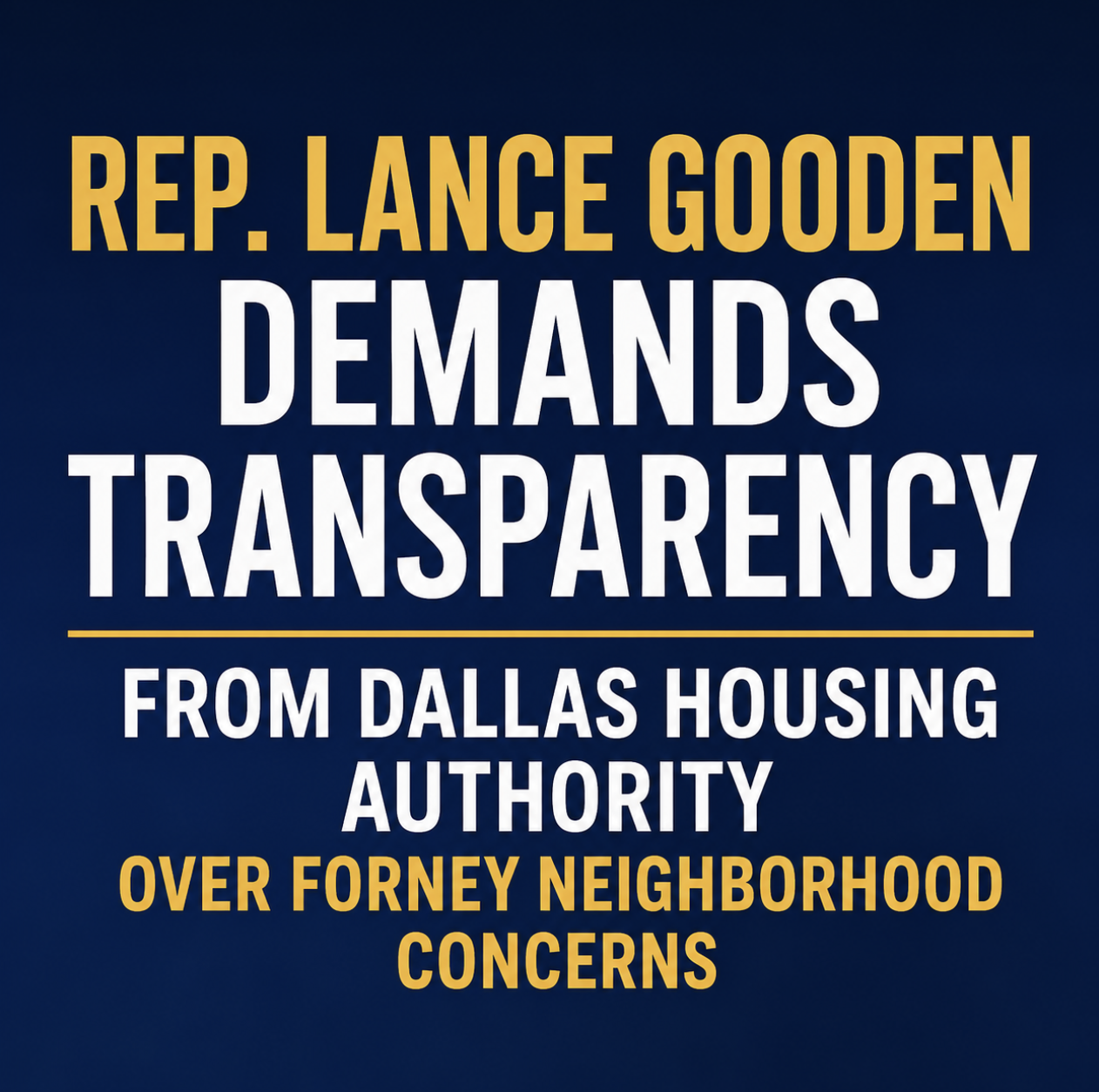
On June 2, 2026, Lance Gooden put his congressional letterhead behind a request from homeowners in a Forney subdivision.
Fourteen of the twenty houses going up on one street in the Gateway Parks subdivision, the homeowners had told him, would be eligible to be rented to families holding federal Housing Choice Vouchers. Gooden wrote to the president of the Dallas Housing Authority and asked him to explain himself.
You can read the whole letter on his own website. It opens like this:
"I write to address my concerns regarding housing concentration and community stability issues affecting portions of Kaufman County, including the Gateway Parks subdivision in Forney, Texas."
Housing Choice Vouchers — most people know them as Section 8 — are how a working family that can't cover market rent pays for a place to live. The voucher goes to the household, not the building. It is the federal government's main program for helping low-income families afford housing in the private market.
A congressman who wants to know how that program works is entitled to ask. But look at what Gooden actually asked for.
He wanted ten years of maps
The letter makes five demands of the Dallas Housing Authority, with a June 26 deadline. Here is the first one, verbatim:
"Aggregate and tract-level data regarding Housing Choice Voucher placements within Kaufman County over the past ten years, including trends in placement concentrations within specific subdivisions or census tracts."
Census-tract-level data on where voucher families have been placed, subdivision by subdivision, going back a decade. He also asked for the housing authority's policies for evaluating "geographic concentration or deconcentration outcomes associated with voucher placements in suburban-receiving communities," and whether the authority weighs impacts on "neighborhood stability, HOA solvency, or long-term homeownership opportunities."
In his press release announcing the letter, Gooden framed it this way:
"Housing programs should support both homeowners and renters while preserving the values that make our rural communities great places to live, raise a family, and build a future."
He copied the U.S. Department of Housing and Urban Development on the letter, so the agency would know a member of Congress was watching.
The case he cited was about keeping Black families out
The third item on Gooden's list is the one that gives the letter away. He asked the Dallas Housing Authority for:
"Current DHA guidance, criteria, or metrics used to evaluate deconcentration objectives associated with Walker v. HUD within Kaufman County and neighboring suburban jurisdictions."
Walker v. HUD is not an obscure regulation. It is a federal civil rights case filed in Dallas in June 1985 — case number 3:85-cv-01210 — brought by Black public housing residents.
The court found that the Dallas Housing Authority, HUD, and the City of Dallas had run public housing on a policy of deliberate racial segregation. The consent decree recognized that the housing authority had "operated its program to enforce racial segregation and prevent black individuals from moving into predominately white areas."
The remedy was the whole point of the case: get assisted families out of concentrated, segregated poverty and into the rest of the metro area. Courts ordered thousands of new assisted housing units, money for housing in predominantly white areas, and eventually a dedicated pool of "Walker settlement vouchers" that could only be used in non-Black, non-poverty-concentrated neighborhoods — with rents covered above the normal cap specifically so families could afford to move there.
"Deconcentration," in Walker, means one thing: making it possible for a Black family in West Dallas to rent a house in a suburb.
That is the legal framework Gooden asked the housing authority to justify — in a suburb, on the receiving end, on behalf of homeowners who noticed how many of the new houses on their street would take vouchers.
The case ran for decades. The court's remedial findings identified the specific harms it was fixing, including that Black families using Section 8 ended up in neighborhoods with higher crime, worse city services, industrial hazards, and underperforming schools far more often than white families did. The suburban placements Gateway Parks homeowners are complaining about are the remedy working.
Gooden used the word "concentration" six times in a letter that runs about four hundred words. In Walker, concentration is the disease. In Gooden's letter, dispersal is.
This isn't his committee
Gooden sits on the House Judiciary and Armed Services Committees. Federal housing policy — HUD, the voucher program, the Dallas Housing Authority — belongs to the Financial Services Committee, which he is not on.
So this letter is not oversight. He has no subpoena power over the Dallas Housing Authority, no jurisdiction over its budget, and no hearing to bring anyone to. What he has is a congressman's letterhead, a deadline, and a copy to HUD. That's a message, and the housing authority is meant to read it.
Who pays for his campaign
Gooden's letter is careful to blame "institutional investor ownership" — corporate landlords buying up single-family homes and renting them out — alongside the vouchers. That's a real problem in North Texas suburbs, and it would be a fine thing for a member of Congress to go after.
He hasn't gone after it. He went after the tenants' program.
Federal Election Commission records show the National Apartment Association's political action committee — the trade group for apartment owners and property managers — has given Gooden's campaign $45,000 across fourteen contributions since 2018, starting with $2,500 in June 2018 and running through $5,000 in April 2025.
That money sits inside a campaign that runs almost entirely on organized interests. Of the $4.96 million Gooden has raised since 2020, $2.45 million came from PACs — just under half. Small grassroots donors gave $35,785 total, about seven-tenths of one percent. That ranks him #324 out of 440 House members in grassroots funding.
Gooden is not a man who gets his housing views from the people who need housing.
The pattern
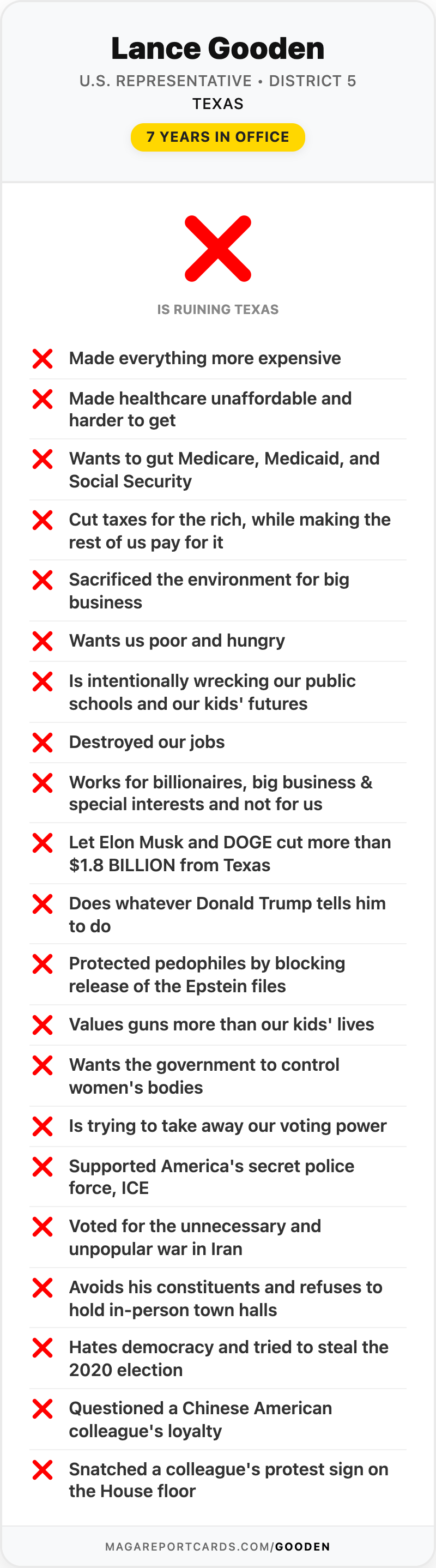
This is the same congressman who went on Fox News in February 2023 and said of Rep. Judy Chu — the first Chinese American woman elected to Congress — "I question her either loyalty or competence." Chu called the remarks racist. The House Democratic leader called them "dangerous, unconscionable and xenophobic." Gooden did not apologize.
It's the same congressman who grabbed a "This is not normal" sign out of Rep. Melanie Stansbury's hands at Trump's March 2025 address and tossed it away.
And it's the same congressman currently under House Ethics Committee investigation — over what he says is a spending matter, though the committee has not said — whose response to the referral was to call the investigators "dishonest unelected OCC bureaucrats" before anyone had said what he was accused of.
What he's actually asking for
Strip out the procedural language and Gooden's letter asks the Dallas Housing Authority a single question: why are these families being allowed to move here, and how many more are coming?
He asked it on his constituents' behalf, and he cited — as the standard the housing authority should be measured against — a federal desegregation order built to make exactly those moves possible.
Nobody has to guess what the answer is. It's in the case he cited.
Source
Gooden's June 2, 2026 letter to the Dallas Housing Authority and his own press release, reported locally by inForney. Image via inForney.