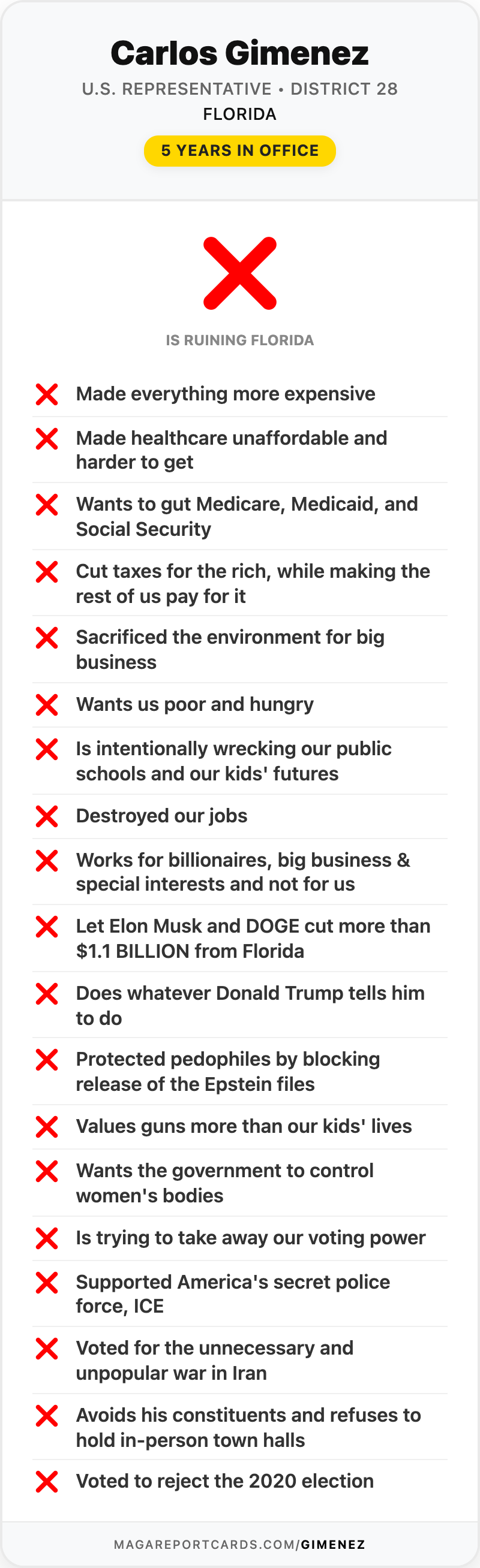
Carlos Gimenez has been in Congress since January 2021. In that time he has introduced 50 bills. According to his own record on Congress.gov, not one of them has become law.
Seven of them passed the House. Only one ever made it through the Senate too. It went to President Trump in December 2025 — and Trump vetoed it.
Then, when the House had a chance to override that veto, 188 of Gimenez's fellow Republicans voted to let it die. Sixteen of them were from Florida.
The bill: keep a tribal village from flooding
The bill was called the Miccosukee Reserved Area Amendments Act. Gimenez introduced it on January 16, 2025, four days before Trump took office.
It was small and local. The Miccosukee Tribe has a village in the Everglades called Osceola Camp. People live there, but the camp sits outside the land the federal government set aside for the tribe. Gimenez's bill would have added the camp to the tribe's land, and told the Interior Department, "in consultation with the Tribe," to "take appropriate actions to protect structures" in the camp "from flooding," according to the bill text read into the Congressional Record.
Gimenez sold it on the House floor in July 2025:
"This bipartisan legislation ensures that the Miccosukee Tribe has the legal authority to manage, protect, and preserve their land and continue their traditional way of life."
He called it a bill "about fairness and conservation."
Nobody disagreed. The House passed it by voice vote on July 14, 2025. The Senate passed it with no objection on December 11. It went to the president on December 18.
Trump killed it to punish the tribe
On December 29, 2025, Trump vetoed it. It was one of the first two vetoes of his second term.
He didn't pretend it was only about the bill. Alongside a cost argument, his veto letter went after the tribe, saying it had "actively sought to obstruct reasonable immigration policies that the American people decisively voted for when I was elected."
What the tribe had done was go to court. The Miccosukee are part of a lawsuit claiming Florida broke federal environmental rules when it built "Alligator Alcatraz," the 3,000-bed immigration detention camp in the Everglades.
So a tribe sued over a detention camp built on its doorstep. In return, the president took away the flood protection a Republican congressman had written for its village. Florida's Republican attorney general, James Uthmeier, cheered: the tribe "shouldn't expect taxpayers to bail them out," he wrote.
We've already written about what federal inspectors later found inside that camp: 79 people held in metal cages about four feet wide.
The other bill Trump vetoed that day was a water pipeline for southeastern Colorado, written by Lauren Boebert. She later said she was told why: Colorado was keeping a convicted election official in prison.
188 Republicans voted to keep it dead
The House voted on the veto on January 8, 2026. Overriding a veto takes two-thirds of the House. It failed, 236 to 188.
Every Democrat who voted, all 212 of them, voted to override and save the Republican congressman's bill. Republicans voted 188 to 24 to sustain Trump's veto.
Gimenez voted to override, and so did his two Miami-area Republican neighbors, Mario Diaz-Balart and Maria Elvira Salazar. But 16 other Florida Republicans voted to keep the veto. That includes Byron Donalds, Anna Paulina Luna, Brian Mast and Jimmy Patronis.
The Associated Press noticed something else. Gimenez did not speak on the floor before that vote. Instead, the AP reported, it was a Democrat, Florida's Debbie Wasserman Schultz, who urged the House to override.
In July, Gimenez stood up to sell his bill to a House that already agreed with him. In January, when his own party was about to kill it, he left it to a Democrat to defend it.
The same AP story described Gimenez as a Republican "whom Trump has endorsed."
Fifty bills, zero laws
The veto was the closest Gimenez has come to getting a law passed. Here is the rest of his record, from Congress.gov:
- 50 bills introduced since 2021: 23 in his first term, 18 in his second, and 9 so far in this one.
- 7 of them passed the House. Most were small homeland security bills, like one to stop the Department of Homeland Security from buying batteries from certain Chinese companies. That one has passed the House twice, in 2024 and again in 2025. Neither time did it become law.
- 1 passed the Senate. That was the Miccosukee bill.
- 0 became law.
Gimenez chairs a Homeland Security subcommittee and sits on the Armed Services Committee. His party controls the House. In 2025 and 2026 it controlled the Senate and the White House too. He has never been in a better position to get something done.
He is running for a fourth term in November, and he has no law to show for his first three.
What the record shows
Carlos Gimenez has introduced 50 bills in Congress since 2021, and none have become law. The only one to pass both chambers would have protected a Miccosukee village in the Everglades from flooding. Trump vetoed it in December 2025, saying the tribe had obstructed his immigration policies, after it sued over Alligator Alcatraz. In January, 188 House Republicans, including 16 from Florida, voted to keep that veto, and Gimenez left it to a Democrat to argue for his own bill on the floor.
Sources
- Trump vetoes Miccosukee flood protection, citing tribe's opposition to 'Alligator Alcatraz', Florida Phoenix, December 31, 2025
- H.R. 504, Miccosukee Reserved Area Amendments Act: all actions, Congress.gov
- Roll call 8, January 8, 2026: veto override on H.R. 504, Office of the Clerk, U.S. House of Representatives
- House refuses to override Trump vetoes as Republicans stick with president, Associated Press, January 8, 2026
- Rep. Carlos Gimenez: sponsored legislation, Congress.gov