Politicians who have nothing to hide usually don't fight this hard to keep records secret.
In April 2026, the Pennsylvania Democratic Party filed a simple public-records request. It asked Pennsylvania Treasurer Stacy Garrity to turn over communications about a 2022 change she made to how the state invests its money. More than a month later, her office said no — and called the request a "fishing expedition."
That's a strange answer for a public official. Open-records laws exist precisely so regular people can see how their government makes decisions with their money. When the person in charge of billions of dollars in public funds refuses to show her work, it's worth asking what she doesn't want us to see.
What She's Hiding
Back in 2022, Garrity's office rewrote Pennsylvania's Investment Policy Statement — the rulebook for how the Treasury invests public dollars. The revision stripped out language directing the state to weigh environmental and social impact when it invests.
On its own, that's a policy choice. But it doesn't happen in a vacuum. Garrity has spent her time as Treasurer as a vocal defender of the fossil-fuel industry. In 2021 she joined a group of Republican state treasurers threatening to yank public money out of banks that refused to keep lending to coal, oil, and gas companies. She has personally received income from natural gas companies.
So when Garrity quietly deleted environmental considerations from the state's investment rules, the obvious question is: who did that help? The records request was an attempt to find out — to see the emails and conversations behind the change. And that is exactly what her office refused to release.
"Fishing Expedition" Is What People Say When They Got Caught Something
Garrity's office dismissed the whole request as "akin to political opposition research."
But the public's right to know how its government works doesn't disappear just because the person asking is a political opponent. Sunshine laws apply to everyone — friend and foe alike. If the 2022 change was an honest, above-board policy decision, the simplest way to prove it would be to hand over the paperwork and let people see for themselves.
Instead, Garrity chose secrecy. For someone running to be Pennsylvania's next governor — the most powerful office in the state — that should set off alarms. Voters overwhelmingly say corruption in government is a serious problem. Garrity just gave them a fresh reason to worry.
This Fits a Pattern
Hiding records isn't a one-off for Garrity. It's part of a bigger story about who she actually works for.
Look at her record:
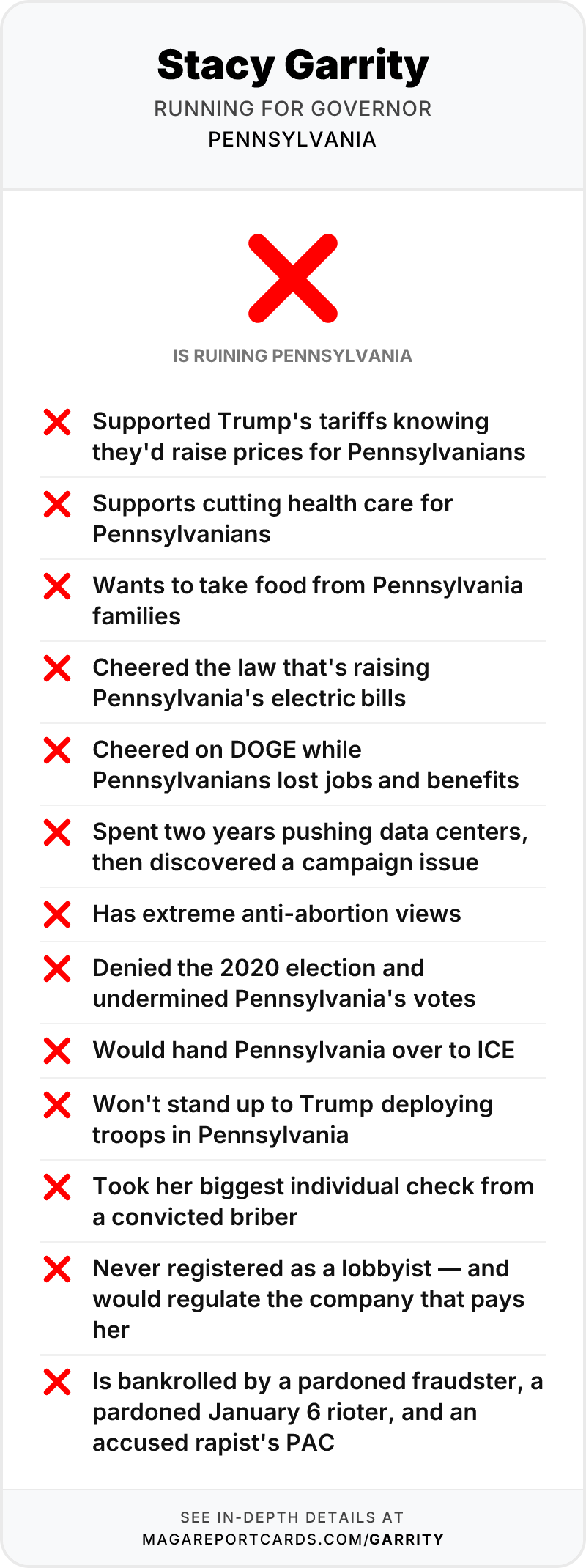
- She supported Trump's "One Big Beautiful Bill," which is estimated to push about 293,000 Pennsylvanians off Medicaid.
- She praised the same bill — which cut food assistance — for "reducing wasteful spending," while nearly 2 million Pennsylvanians rely on SNAP.
- Asked whether Trump's tariffs would raise prices, she backed them anyway, calling them "very short-term pain" for "a very long-term gain."
Over and over, Garrity has sided with Trump, the powerful, and the fossil-fuel industry over ordinary Pennsylvanians. The records she's now refusing to release could show us another example of exactly that — a quiet change that served her industry friends rather than the taxpayers she's supposed to protect.
We may not know everything in those documents yet. But we know this: a Treasurer who is proud of her decisions doesn't hide the paper trail. And a candidate who wants to run the whole state shouldn't get to decide which questions the public is allowed to ask.
Pennsylvania Deserves Better
Transparency isn't a favor politicians do for us. It's the bare minimum we should expect from anyone who handles our money. Stacy Garrity failed that test — and she failed it on a decision that just happens to line up with the interests of the industry she's spent years defending.
When she's asked to open the books, she calls it a "fishing expedition." Pennsylvanians should call it what it looks like: a public official who'd rather keep us in the dark.
Source
This post is based on reporting by American Journal News: "Garrity's office rejected records request that could expose corruption."