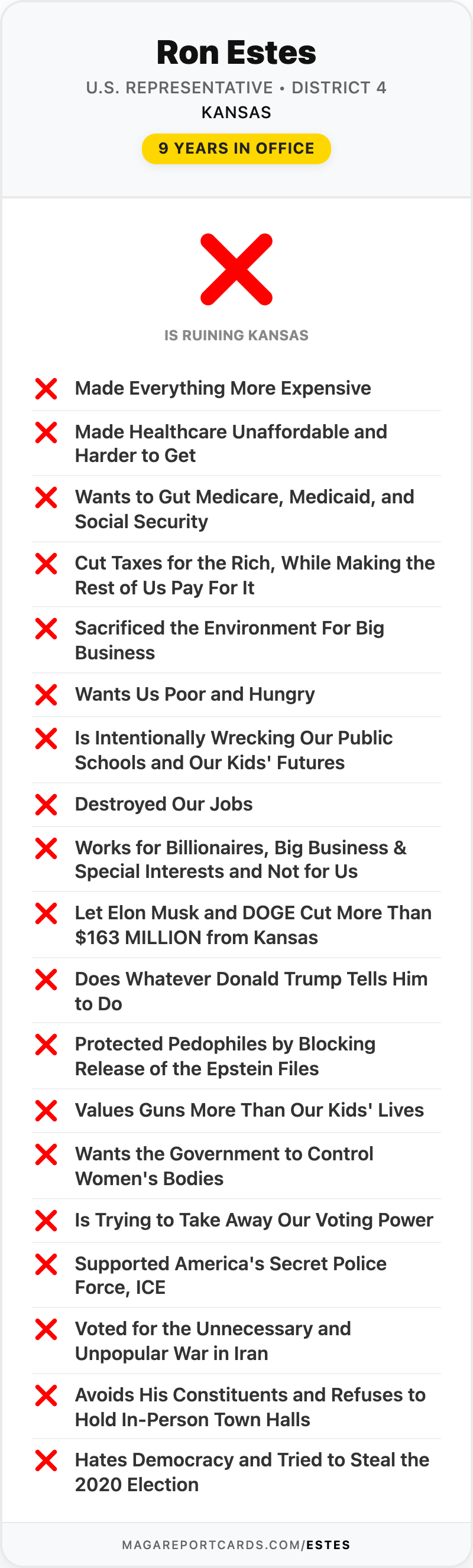
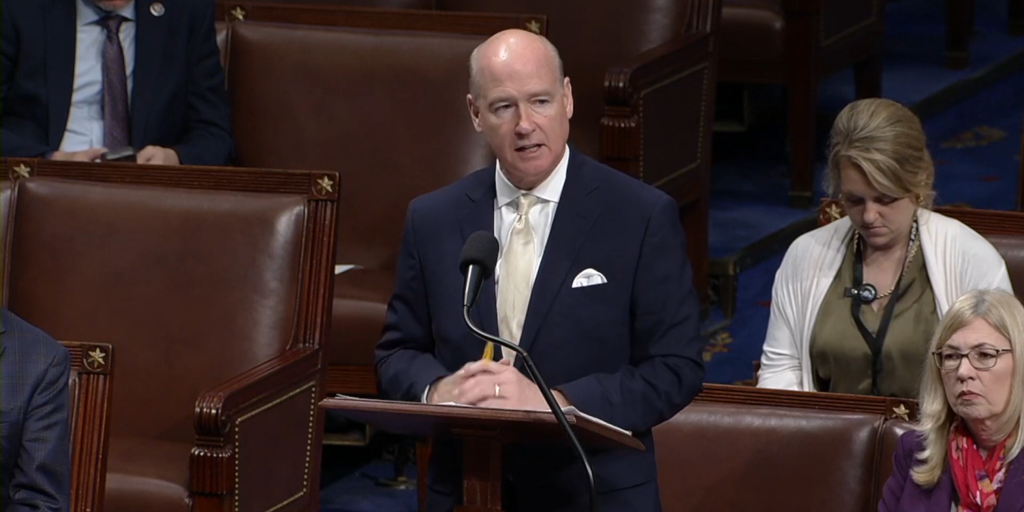
On June 1, 2026, Ron Estes announced that he had led a letter to Health and Human Services Secretary Robert F. Kennedy Jr., asking him to bring back the 2019 Title X rule known as the "Protect Life Rule."
He wasn't one of 159 signatures. He was the person who organized it, alongside Sen. Cindy Hyde-Smith and Rep. Virginia Foxx. His office notes he also led the same push back in 2018.
Here's what he said:
"Leading this letter is about restoring basic program integrity... By reissuing the Protect Life Rule, the Trump Administration will once again draw a bright, undeniable line of physical and financial separation between actual family planning services and elective abortion activities."
"Basic program integrity" sounds like paperwork. It isn't. We already know exactly what this rule does, because it was law for about two years, and somebody counted.
What Title X is
Title X is the federal family planning program. It's been around since 1970. It pays for birth control, cancer screenings, testing for sexually transmitted infections, and basic reproductive health care for people who are low-income or uninsured — the person who doesn't have a regular doctor and shows up at a clinic.
Before 2019, the program ran through about 4,000 clinics and served roughly 4 million patients a year, according to KFF.
The 2019 rule Estes wants restored did two things. It banned clinics in the program from referring a patient for an abortion — including a patient who asks. And it required "physical and financial separation," meaning a clinic that also provided abortion care with its own non-federal money had to build separate facilities or leave.
Lots of them left.
The number nobody in that letter mentions
The Guttmacher Institute counted the damage in February 2020. Its findings:
- An estimated 981 clinics left the Title X network in 2019 — about one-quarter of every site in the program.
- The network's capacity to provide women with contraceptive services fell by at least 46% — roughly 1.6 million patients worth.
- Six states ended up with no Title X provider at all: Hawaii, Maine, Oregon, Utah, Vermont and Washington.
- In Connecticut, Illinois, Maryland and New York, capacity dropped 90% or more.
The patient count tells the same story. KFF found the number served fell from about 4 million to 1.54 million in 2020 — losses KFF says were compounded by the pandemic. And it never came back. As of 2023, Title X was serving 2.8 million people — a million fewer than before the rule took effect.
That is not "program integrity." That is a program cut roughly in half, and it stayed cut.
Estes's own press release actually concedes the mechanism, in a single sentence: "During the first Trump Administration, the organization withdrew from the program to avoid complying with the rule." He means Planned Parenthood. What he leaves out is that hundreds of clinics that were not Planned Parenthood walked out too — state health departments, university clinics, community health centers — because they could not afford to build a second building or would not agree to withhold information from a patient who asked for it.
The "gag" part
The 2019 rule is called the domestic gag rule for a reason. Under it, a clinician whose patient asked where she could get an abortion was barred from telling her.
Not barred from performing one. Not barred from paying for one — federal law has barred Title X money from being used in programs where abortion is a method of family planning since the program was created. Barred from answering the question.
That is the policy Estes led a letter to bring back, and it's the piece he described as drawing a "bright, undeniable line."
This is a pattern, not a one-off
Estes has been on this specific issue for eight years. When the rule was first proposed in 2018, he led the congressional letter supporting it — his office says so — and on May 21, 2018 he went to the House floor to praise it.
It fits a longer record. He ran for Congress in 2017 promising voters that "one of my top priorities will be to defund Planned Parenthood." He signed a discharge petition trying to force a floor vote on the Born-Alive Abortion Survivors Protection Act. He voted for the 2025 budget bill that blocked Medicaid payments to Planned Parenthood and its affiliates nationwide. He voted against the Women's Health Protection Act, which would have protected abortion access nationwide, and against the Right to Contraception Act. Reproductive Freedom for All scores him 0% for 2025.
The letter is the same project, aimed at the last piece of the program still standing.
What it means in Kansas
Kansas is a state where voters already answered this question. In August 2022, Kansans rejected a constitutional amendment that would have stripped abortion rights from the state constitution — 59% to 41%, an 18-point margin, on a primary ballot, with turnout nobody predicted.
Estes represents the Wichita area. His constituents were part of that vote. Then he went to Washington and organized a letter asking a cabinet secretary to reimpose the rule that emptied out a quarter of the nation's family planning clinics.
The people who lose here are not activists on either side. They are the woman who uses a Title X clinic because it's the only place that will see her without insurance — for her birth control, her Pap smear, her STI test. When 981 clinics walked out last time, those appointments didn't move somewhere else. They just stopped.
Estes is asking for that again, and he's the one holding the pen.
Source
Rep. Estes's own announcement: Rep. Estes Leads Letter to Reissue the Protect Life Rule, June 1, 2026.