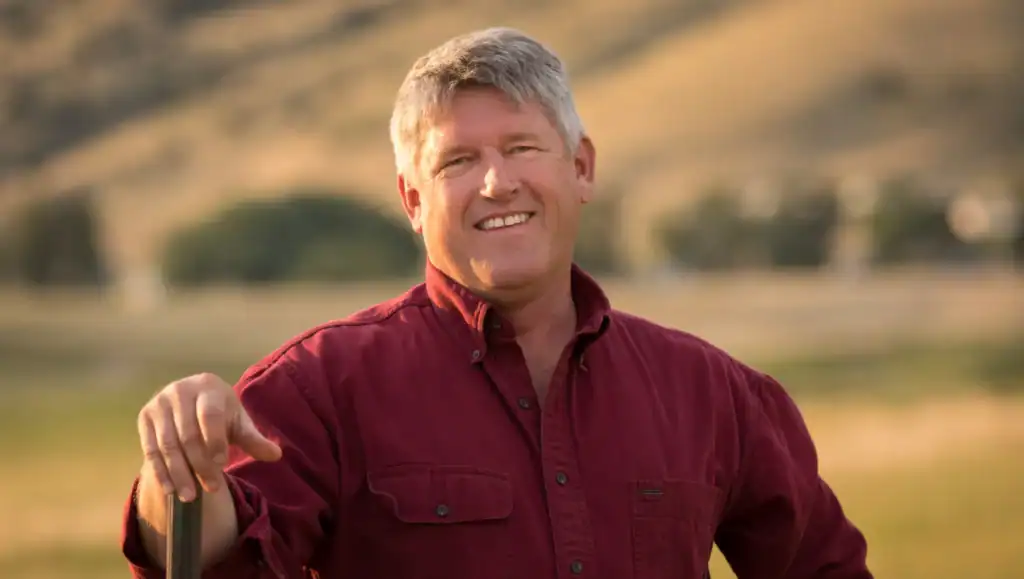
In an interview published July 2, 2026, Troy Downing gave the Washington Reporter this:
"340B is crazy; it's the largest drug program and growing. It was intended for the uninsured, lower income people. As we've seen uninsured numbers drop, 340B has grown. Something is going on there."
Downing represents Montana's 2nd District — the eastern district, the rural one, the one full of towns whose hospital is the only hospital for eighty miles. 340B is a substantial part of the reason those hospitals are still open — protecting it sits at the top of the Montana Hospital Association's federal agenda, which it carried to Montana's congressional delegation this year.
What 340B is
Congress created the 340B Drug Pricing Program in 1992. It requires drug manufacturers that want to sell to Medicaid to sell outpatient drugs at steep discounts to safety-net providers — community health centers, and hospitals that serve rural or low-income populations.
For a small rural hospital, as MPR News laid out in a detailed June 2026 report, it works like this: the hospital buys the drug at a deep discount, bills the patient's insurance at the regular rate, and uses the difference to fund operations. Not a windfall — payroll, an ER that's actually staffed, a labor-and-delivery unit in a county that doesn't have enough births to pay for one.
MPR interviewed rural hospital leaders across Minnesota, whose facilities run on the same math as Montana's. Rachelle Schultz, president and CEO of Winona Health, put it in one sentence: "Every one of us would be out of business without 340B."
Lisa Bjerga, CEO of Lakewood Health Systems in Staples, a rural community about an hour northwest of St. Cloud, described what patients get out of it:
"[Patients see] the savings when the ambulance picks them up at their house to bring them to our ER that is staffed. We don't pass it on to the patient, but we pass it on in the form of access."
Downing is not wrong that the program has grown far beyond what its authors imagined, and the critique he's echoing is real. A 2022 Wall Street Journal investigation found the Cleveland Clinic — one of the wealthiest hospital systems in the country — earned $1.35 billion in 340B profits in a single year by classifying itself as a "rural referral center." The University of Minnesota researcher MPR consulted said she doesn't "think that policymakers could have envisioned that we would be where we are today."
But that is an argument for fixing who qualifies. It is not what Downing said. He called the program itself crazy, and the people who would feel a squeeze on it first are not the Cleveland Clinic. They are places like Big Sandy.
Big Sandy, Montana
Big Sandy sits in Chouteau County, in Downing's district, about eighty miles from the nearest major town. Its population is around 800.
Big Sandy Medical Center's emergency department, NPR and KFF Health News reported in March 2026, is one room with two beds and a curtain between them. The building was put up by farmers and ranchers in 1965. Its former CEO, Ron Wiens, said it needs at least $1 million in deferred maintenance including a failing HVAC system — and that the hospital has struggled to make payroll each month.
It stays open on donations, grants, and thin margins.
Shane Chauvet, a Big Sandy cattle rancher, was stabilized in that one-room ER after a flying piece of metal nearly severed his arm in a windstorm. The power was out. No helicopter could fly. Staff kept him alive until an ambulance could take him eighty miles through rain and hail.
That's the kind of hospital 340B revenue holds together. And these hospitals are already under strain from something Downing did vote on.
The part where his own argument turns on him
Read Downing's sentence again: "As we've seen uninsured numbers drop, 340B has grown."
The number of uninsured Americans is not about to keep dropping. The Joint Economic Committee projects 22,601 people in his own district will lose their health coverage: 15,801 losing Medicaid under the budget bill Downing voted for, and 6,800 losing Affordable Care Act coverage, mostly because the extra premium tax credits expired. The day it passed he called it "a big win for Big Sky Country" that "strengthens critical programs."
That same law is expected to cut Medicaid spending by nearly $1 trillion over ten years. Rural hospitals in Montana are now planning for more uninsured patients walking through the door and less money to treat them. Congressional Republicans attached a $50 billion Rural Health Transformation Program to the bill as a sweetener; Montana got more than $233 million in its first-year award. But Montana is one of at least ten states whose leaders say the program may push rural hospitals to cut services in order to keep emergency care running — the state's application talks about "right-sizing select inpatient services," which it acknowledges can mean "downsizing."
Wiens described what that language does to a hospital administrator: "That's what has all the hospitals on pins and needles, words like restructuring, reducing inpatient beds. Everybody is going, 'What is this going to look like?'"
So the sequence is: vote for the law that raises the uninsured count and squeezes rural hospital budgets, then point at the uninsured count as the reason 340B deserves suspicion.
Downing rejected the charge that the administration's anti-fraud drive would hurt vulnerable patients:
"When everybody says you are hurting the most needy, no, we are not. We have a duty to taxpayers."
Who is on the other side of this fight
340B is not being debated in a vacuum. The pharmaceutical industry pays for these discounts, and it has spent years working to shrink the program.
Hospitals say manufacturers have been quietly undercutting the program by pulling medications off the list of drugs covered by it. When Minnesota lawmakers moved a bipartisan bill this year to give their state's 340B protections some enforcement teeth, the pharmaceutical industry ran an aggressive TV and social media ad campaign against it, and the bill died without ever being called for a vote. One consequence: starting in July 2027, manufacturers will be able to limit which pharmacies a hospital can use to qualify for the discount.
Rick Ash, CEO of United Hospital District in Blue Earth, Minnesota, described the strategy:
"What I believe to be true is that this is slowly going to be eating the elephant one bite at a time. Eventually, they want to get rid of 340B."
Downing calling 340B "crazy" from a seat in Congress is a contribution to that campaign, whether or not he intends it as one.
He of all people knows what this looks like
Downing is not a newcomer to health insurance policy. He spent four years as Montana's State Auditor and Commissioner of Securities and Insurance, from January 2021 to January 2025 — the state office that regulates insurers and pharmacy benefit managers. He leans on that experience throughout the same interview, describing fraud cases his office uncovered.
Which means he has seen, closer than almost anyone in Congress, how rural Montana health care is actually financed. He knows what a critical access hospital's balance sheet looks like. He knows what happens to a county when its hospital closes.
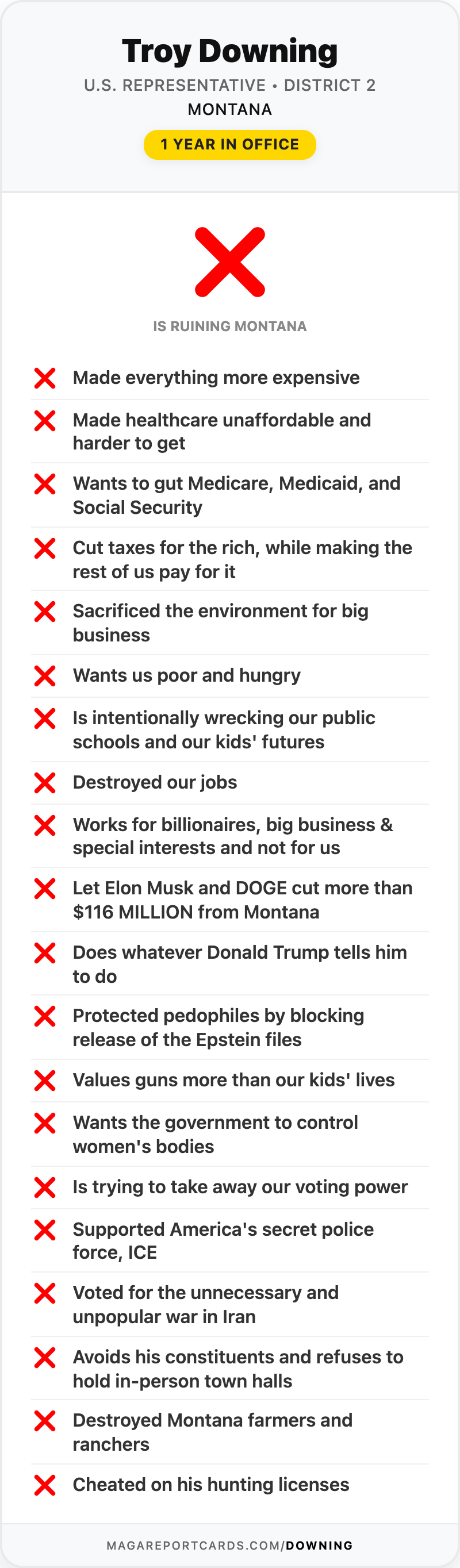
He also isn't especially available to hear from the people it would happen to. Downing has held seven telephone town halls and zero in-person ones since taking office. A May 2026 Montana Free Press–Eagleton poll put his approval in his own deep-red district at 34%, with 40% disapproving — in a seat he won by more than 30 points.
If a program is genuinely broken, the fix is to say which part and name the reform. Downing said "crazy," said "something is going on there," and moved on to fraud prosecutions. The hospitals in Big Sandy and Havre and Miles City don't get to move on.
We deserve better.
Source
Washington Reporter, "EXCLUSIVE: Rep. Troy Downing Calls 340B program 'crazy,' praises Trump's healthcare fraud crackdown", July 2, 2026. Additional reporting: MPR News, NPR/KFF Health News. Photo: Washington Reporter.