The census decides how much power your state gets. It sets how many seats each state has in Congress, how many electoral votes it has for president, and how billions of federal dollars get handed out. That's why messing with the count is so serious.
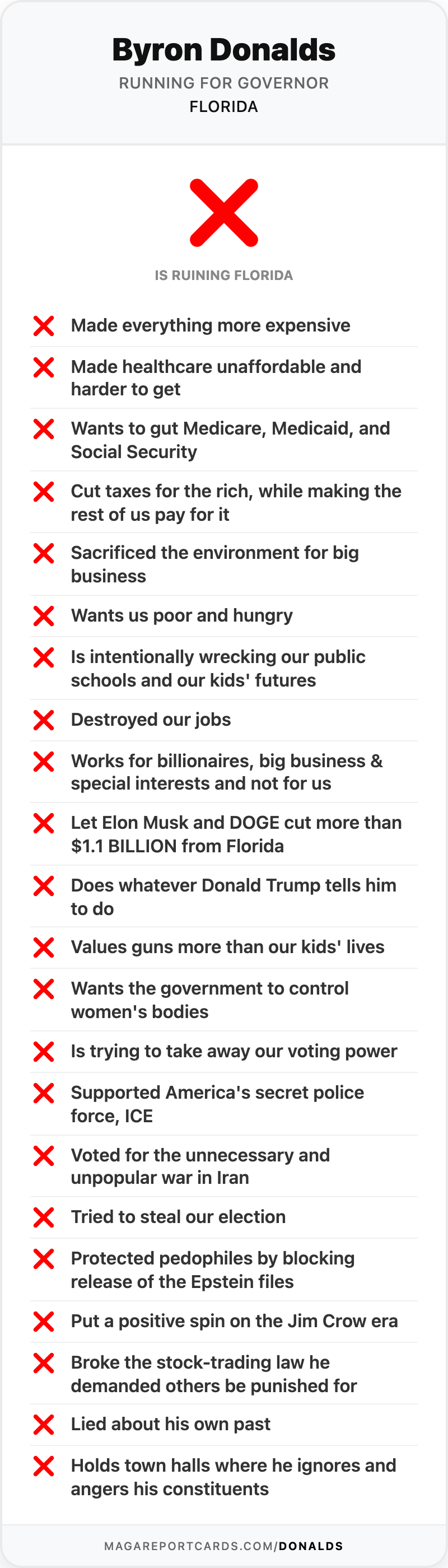
Byron Donalds wants to be Florida's next Governor. And one of the things he's put his name to is a lawsuit trying to force the government to redo the 2020 Census — a lawsuit a federal court has now thrown out twice.
What the lawsuit tried to do
On July 7, 2026, a three-judge federal court in Tampa dismissed the case for a second time — this time "with prejudice," meaning the plaintiffs don't get to try again. The judges said any new version of the complaint "would be futile."
Here's what the suit claimed: that if the 2020 Census had been counted differently, Florida would have gotten an extra U.S. House seat and an extra vote in the Electoral College. The plaintiffs blamed a statistical method called "imputation" — a statistical tool the Census Bureau uses to fill in people at addresses it confirms are occupied but couldn't fully survey.
The case wasn't originally Donalds' idea. It was filed in September 2025 by America First Legal — a group co-founded by White House deputy chief of staff Stephen Miller — on behalf of the University of South Florida College Republicans and the Pinellas County Young Republicans. Donalds became a plaintiff in November, lending a sitting congressman's name and clout to the effort.
The court wasn't buying it
The first time around, in February, the panel tossed the case because the Republicans waited nearly five years to sue. When they filed an amended complaint, the judges dug into the actual numbers — and found the claim fell apart.
In their 68-page decision, the judges wrote that it was "entirely speculative whether the imputation employed in the census for Florida increased or decreased the Florida head count relative to other States." In other words, the very method Donalds and his co-plaintiffs blamed for shortchanging Florida might just as easily have helped it.
The judges also swatted down Donalds' personal claim that the bad count hurt him. He argued he used census data to "inform his votes" and to help constituents with programs like SNAP and Medicare. But the court noted he couldn't name a single vote he would have cast differently, and pointed out he "operated from the same set of Census data" that the programs themselves use. In the court's eyes, he hadn't shown he was hurt at all.
What critics say it was really about
Lawyers who fought the suit say it was never really about 2020 at all.
"From the beginning, it has been clear that the Republicans intended to use this lawsuit to lay the groundwork for a partisan manipulation of the 2030 count," said David Fox of the Elias Law Group, which defended the census on behalf of the Alliance for Retired Americans and two college students.
That fits a bigger pattern in Florida. Gov. Ron DeSantis used the same undercount claim to justify a rare mid-decade redrawing of Florida's congressional maps. And Florida Attorney General James Uthmeier has petitioned the Census Bureau to change the 2030 count — asking it to ask about citizenship and immigration status, and to exclude undocumented and temporary residents, and even their children, from the numbers used to divide up congressional seats. Excluding people from the count is how you shrink some communities' representation and pump up others'.
This isn't the first time Donalds went after an election
If a candidate for governor lending his name to a losing census lawsuit sounds familiar, it should. Florida's Governor sits on the three-member Elections Canvassing Commission that certifies the state's election results — and Donalds has a long record of trying to bend election results his way.
Before January 6, 2021, Donalds announced he would object to certifying the 2020 presidential election — and after the riot he tweeted that the rioters "will not alter my decision to object." Just hours after Trump supporters stormed the Capitol, he voted to reject Joe Biden's win — twice, on Arizona and Pennsylvania. Then he voted against creating an independent commission to investigate the attack.
Now he wants to run the state that certifies Florida's elections. The census lawsuit is one more example of the same instinct: when Donalds doesn't like the numbers, he goes to court — or to Congress — to try to change them.
Why this matters
A fair, accurate census is supposed to be one of the things we can all count on, no matter our party. Twice now, a federal court has thrown out this challenge to the 2020 count — the second time for good. Byron Donalds signed onto it anyway.
"Every Floridian deserves a fair and accurate Census count," Fox said. We agree. We deserve better.
Source
This story is based on reporting by Mitch Perry for the Florida Phoenix. Photo by Mitch Perry / Florida Phoenix.