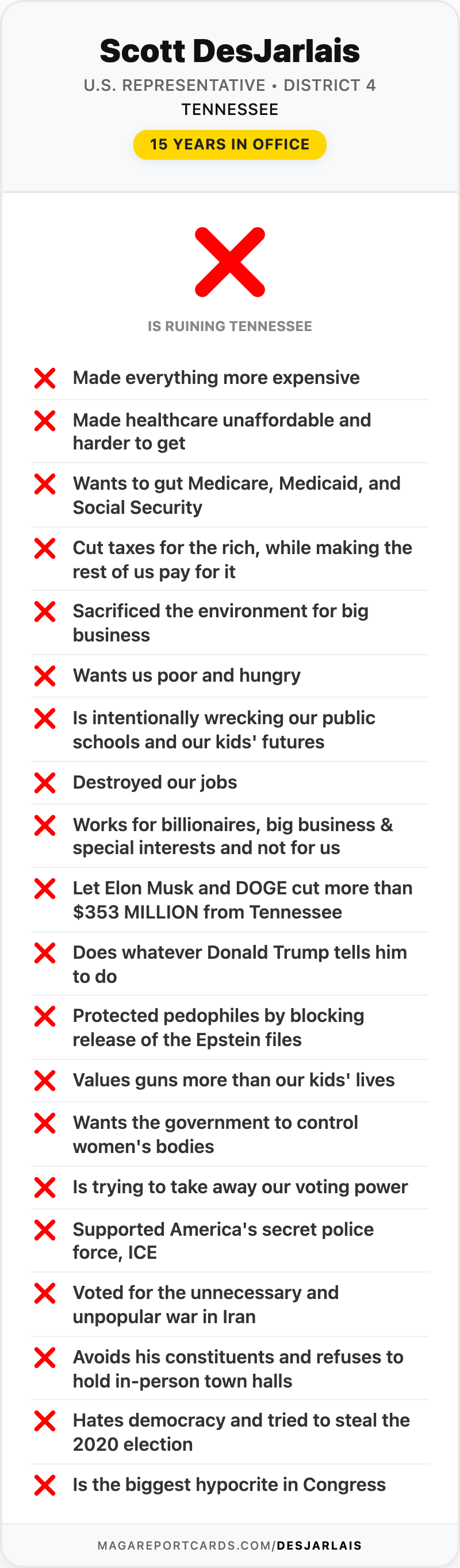
Scott DesJarlais has represented Tennessee's 4th District since 2011 — 15 years in Congress. That's long enough that his record isn't a snapshot anymore. It's a pattern. Here are three parts of it worth knowing before you vote.
1. He voted to throw out a presidential election
Not "raised questions about." Voted.
Hours after a mob attacked the Capitol on January 6, 2021, DesJarlais voted to reject the electoral votes of Arizona and Pennsylvania — the ballots cast by millions of Americans in states he doesn't represent. A week later he voted against impeaching Trump for inciting the mob. Then he voted against an independent, bipartisan commission to investigate the attack, and against the House select committee that ended up doing the work instead.
The votes weren't the half of it. Before January 6, DesJarlais put his name on a series of letters trying to get the machinery of government to reverse the result:
- A November 2020 letter to Attorney General Bill Barr, signed by 39 Republicans, asking for a federal investigation.
- A December 1, 2020 follow-up to Barr asking the Justice Department for subpoenas, search warrants, and the impounding of voting machines.
- The amicus brief of 126 House Republicans backing Texas's lawsuit to throw out the results in Georgia, Michigan, Pennsylvania and Wisconsin. The Supreme Court rejected it.
- A December 17, 2020 letter to congressional leaders demanding hearings into the November election.
All of it rested on a claim that has never held up. The Brennan Center's research on the voter fraud myth and Brookings' review of how widespread election fraud actually is both land in the same place: not very.
If your vote can be thrown out when your congressman doesn't like the result, it isn't really your vote.
2. He cheered on DOGE while the Trump administration took $37.7 million out of Tennessee's universities
DOGE promised to cut $1 trillion from the federal budget, and at one point Musk doubled that goal. DesJarlais was a fan — in February 2025 he went on Nashville's WTN to talk up the House budget and defend DOGE ("I don't know why they're so upset about Elon Musk"), and posted the interview to his own YouTube channel. And when the Rescissions Act of 2025 came up — the package that cancelled about $9 billion Congress had already approved for foreign aid and public broadcasting — he voted yes in June 2025 and yes again in July.
Here's the bill Tennessee got:
- The University of Tennessee system lost $37.7 million across 42 grants the Trump administration terminated, most of it at the UT Institute of Agriculture. Middle Tennessee State lost roughly $640,000 more. Killed projects included infectious disease modeling, vaccine education, and a rural mental health program — in a state with a lot of rural.
- Across the state, DOGE had claimed $352 million in savings from cutting Tennessee grants and leases by May 2025.
And the promised savings never showed up. Analysts who went back through the numbers found DOGE disrupted an enormous amount while saving very little, and it did not reduce overall spending. Tennessee paid the bill anyway.
3. His lifetime environmental score is 2%
The League of Conservation Voters scores every member of Congress on votes affecting clean air, clean water and climate. DesJarlais scored 0% in 2025, and 2% over his entire career.
Fifteen years. Two percent. That means that on essentially every chance he has had to protect the air and water of south-central Tennessee, he voted the other way.
Those votes have a body count attached. The EPA has moved to stop counting the lives saved when it sets air pollution limits — a rule change that makes it much easier to justify letting more pollution through. Analysts warn the rollbacks will increase cancer-causing pollution. Trump's budget bill cut through the country's clean energy programs, and the broader campaign to strip the EPA of its power to act on climate is well documented.
Asthma, cancer, heat — those bills come due locally, in the district, to families who never got a vote on any of it.
So who does Scott DesJarlais work for?
Not the voters — he tried to have millions of their ballots thrown out. Not Tennessee's universities — he cheered on DOGE while their research grants were being cancelled. Not the people breathing the air in his own district — 2% over 15 years is as close to never as a voting record gets.
Ask the question three different ways and you keep getting the same answer, and it's never the people of Tennessee's 4th District. Fifteen years is plenty of evidence. In 2026, the district gets to weigh it.