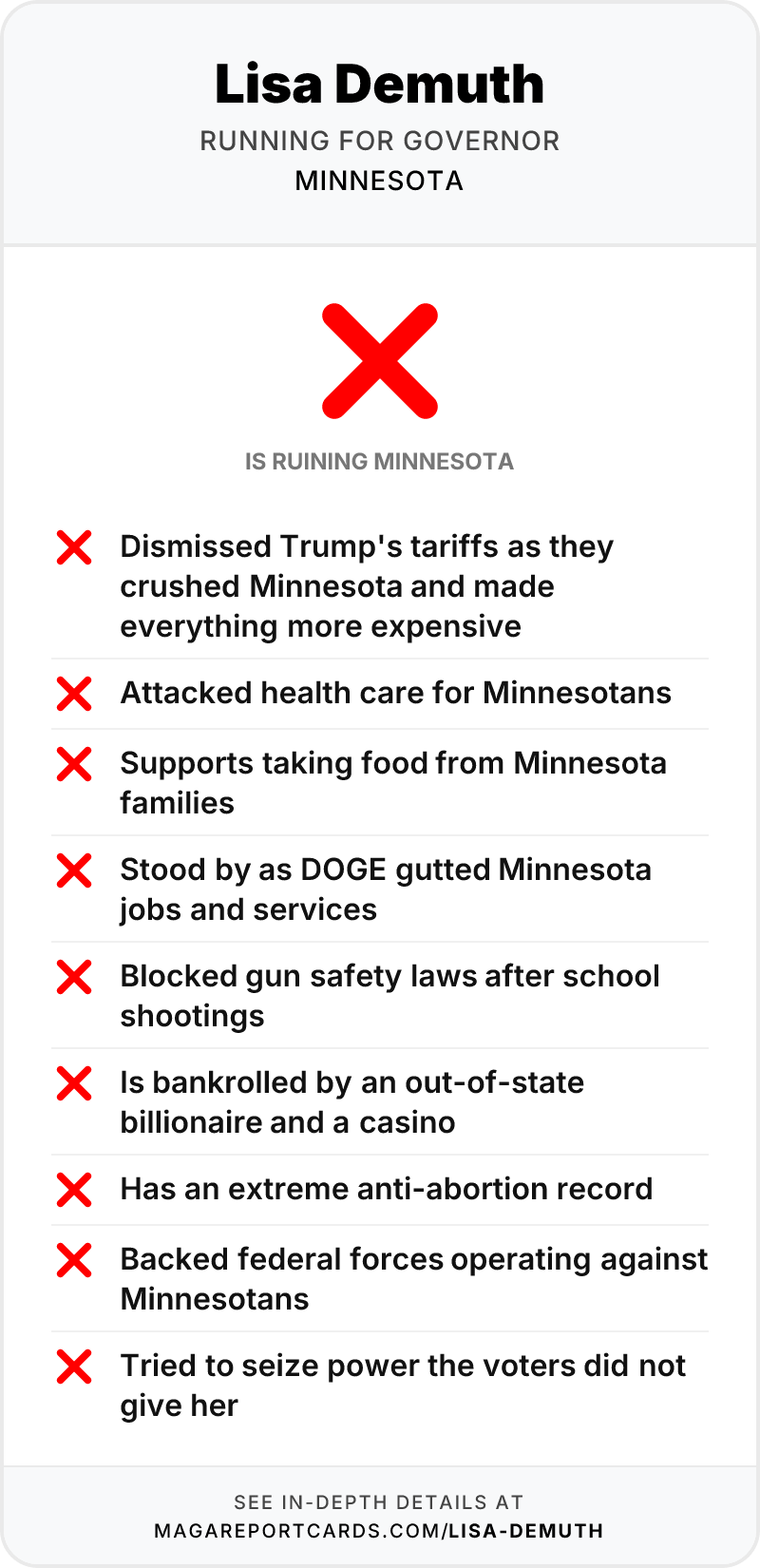
On September 10, 2026, Minnesota House Speaker Lisa Demuth stood at the Capitol with her running mate Ryan Wilson and released her education plan for the state.
Two of the things in it sit badly next to each other.
She was asked whether she would keep Minnesota's universal free school meals, which the state adopted in 2023. Her answer was that some children don't need them.
"When a family is making six- and sometimes seven-figure incomes, their kids do not need free meals."
Her plan also says she would opt Minnesota into a new federal tax credit worth up to $1,700 to taxpayers who donate to scholarship-granting organizations — a provision of President Trump's 2025 budget bill.
The Minnesota Department of Education has already weighed in on that credit, and says it would disproportionately help wealthier Minnesotans. When Republicans brought the opt-in to a House committee in March, the department's director of government relations told them private schools, unlike public ones, are under no obligation to be accessible to every child in the state. The Reformer describes the credit itself as a roundabout version of the private-school voucher program conservative activists have pushed for years.
So the same plan takes free lunch away from families it considers too well off and hands a tax break to families the state's own education agency says are already better off. The difference is what the money is for. One buys a child a meal at a public school. The other subsidizes a donation that can be spent on private tuition.
She could not name a "woke" standard
Demuth's plan promises to remove "'woke' standards adopted by the Walz status quo" and replace them with "evidence-based math and science of reading."
A reporter asked her which standards she meant.
She did not name one. She said her administration would evaluate the state's education mandates and remove standards that "are pushing our kids away from the basics of reading, math and science."
That is not an answer, it is a process for finding an answer later. A candidate who has run on a decade of local school board service and now leads the Minnesota House is in a position to name a specific standard she objects to. The plan names none.
Her plan goes further on the same theme. It calls for changes to Minnesota's teacher licensing board so that the board works to "prepare the next generation of workers and not the next generation of activists."
We have seen that exact proposal this year. In Iowa, Republican gubernatorial candidate Zach Lahn — who co-founded a private school that never sought accreditation, and so was not required to give state tests or hire licensed teachers — wants to expand that state's $314 million voucher program and "wipe out" the board that licenses Iowa's teachers.
"Better teachers deserve better pay," and Minnesota already does this
Demuth said she would bring in teacher pay for performance, because "better teachers deserve better pay."
She could not say what metric would decide which teachers got the money.
And Minnesota already has a teacher payment program tied to performance. More than 100 school districts take part in it. Nothing in her plan explains how hers would differ from the one that exists.
Education Minnesota, the state's teachers union, has endorsed her opponent, Democratic U.S. Senator Amy Klobuchar.
The school safety money comes with a condition
The plan's headline item is school safety, and Demuth has been clear that she wants public, private and charter schools all eligible for state safety aid.
That is not a small detail in Minnesota. DFL Governor Tim Walz has in recent years proposed cutting state aid to private schools to help close budget gaps, and those cuts did not get through the Legislature. Demuth's position turns it around: private schools should get a share of the safety money too.
"Safety for all students in Minnesota matters very much, and we should not just be funding it for public schools," she said, per KTTC's account of the press conference, which reported that she would not sign a school safety package lacking private school funding.
Tied together that way, safety money for Minnesota's public school children becomes leverage for private school funding. The public school money is what gets held.
The problem she is describing is real
The part of Demuth's case that holds up is the diagnosis. Minnesota's academic results have not recovered from the pandemic. Fewer than half of the state's public school students met grade-level expectations in reading and math last year, and many districts have not returned to their pre-pandemic test scores.
That is a genuine emergency, and it is the reason this plan deserves to be read closely rather than waved through.
Read closely, the plan responds to that emergency by means-testing school lunch, moving money toward private tuition through a federal tax credit, letting districts opt out of state mandates including paid family leave, restructuring the board that licenses teachers, and removing curriculum standards it declines to identify. None of that puts a reading specialist in a classroom.
Who is paying for this campaign
It is worth knowing who is funding the candidate making these proposals. A PAC tied to Demuth's run for governor has taken about $1.1 million from a group funded by billionaire Richard Uihlein, one of the country's largest funders of anti-abortion and anti-LGBTQ causes.
The voucher pattern has the same shape elsewhere. In Tennessee, Club for Growth and billionaire Jeff Yass put $3 million into a PAC boosting Marsha Blackburn, the only one among the top candidates in that primary who is "100% behind" expanding private-school vouchers.
What the plan says
Lisa Demuth's education plan, released September 10, 2026, would means-test Minnesota's universal free school meals on the grounds that children in six- and seven-figure households "do not need" them, while opting the state into a federal tax credit of up to $1,700 for donations to scholarship organizations — a roundabout private-school voucher, in the Reformer's description — which the Minnesota Department of Education says would disproportionately benefit wealthier Minnesotans. It would let districts opt out of state mandates including paid family leave, restructure the teacher licensing board so it trains "workers and not activists," add a teacher performance-pay program she could not describe a metric for and that Minnesota already runs in more than 100 districts, and remove "woke" standards she was asked about and could not name. Fewer than half of Minnesota's public school students met grade-level reading and math expectations last year.
Source
Michelle Griffith, Demuth proposes teacher performance pay, wants changes to free school meals, Minnesota Reformer, September 10, 2026, and KTTC's account of the same press conference. Photo by Michelle Griffith / Minnesota Reformer.