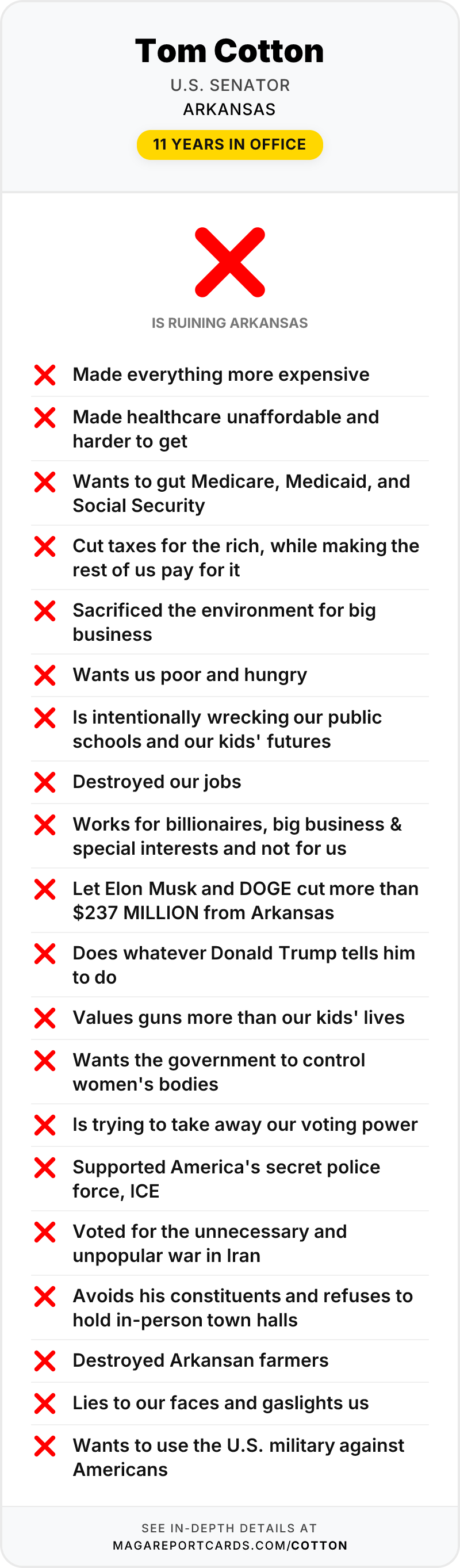
On July 31, the Trump administration rejected Arkansas's request to renew ARHOME — the state's hybrid Medicaid expansion, which covers more than 200,000 low-income Arkansans. The waiver runs out December 31.
Two weeks later, Tom Cotton was back in Arkansas for a day and a half of looking folksy — a fish fry in North Little Rock, a hard hat at the North Little Rock Rail Yards. Then he stood next to Attorney General Tim Griffin at a press conference announcing a federal Medicaid-fraud bill, and said this:
"Medicaid is an important program for sick children, pregnant women, the elderly, and the poor."
That is a lovely sentence. It's also a sentence from a man who voted for the law that just put 200,000 of those people's coverage on a countdown clock.
What actually happened to ARHOME
ARHOME isn't some fringe program. Arkansas built it in 2013 as a compromise between a Democratic governor and a Republican legislature — instead of enrolling people in traditional Medicaid, the state uses the money to buy them private insurance. Republicans in Arkansas have defended it for over a decade precisely because it isn't government-run coverage.
The federal government rejected the renewal on budget neutrality grounds. In plain English: the rules require the program not to cost Washington more than it would have spent without it, and under the new federal law, Arkansas couldn't clear that bar. Separately, Centene — one of the two insurers selling coverage through ARHOME — announced in July that it would leave the program next year, though the state says that decision is unrelated to the federal rejection.
The rules that tightened? Those came from the One Big Beautiful Bill Act — Trump's budget bill. Cotton voted for it.
Arkansas has since gone back and asked for a two-year reprieve to keep the program alive through 2028. That is what a state does when the floor gives out.
Cotton's answer: it wasn't really me
Asked directly about his vote and what it did, Cotton didn't defend the cut. He reframed it until it belonged to somebody else.
First, he described the budget bill as basically a fraud crackdown:
"It was the large budget bill last year that was designed in part to try to crack down on various kinds of Medicaid fraud across the country."
Then he described the provision squeezing ARHOME as a formality that changed nothing:
"It simply codified a longstanding internal practice at the Department of Health and Human Services when it comes to the Medicaid expansion under Obamacare."
If it simply codified a longstanding practice — if nothing changed — then why did a program that had been renewed for over a decade suddenly fail the test?
And finally, he handed the problem to Little Rock:
"It's primarily a decision for our legislature and the Governor, but Senator Boozman and I and our four Congressmen stand ready to help any way we can as they move forward."
Read that as a voter. The U.S. senator who voted for the federal law says the consequences of that federal law are a state problem, and he stands ready to help with them.
"Con artists and criminals"
Here's the full version of Cotton's warm words about Medicaid, with the part that usually gets left out of the clip:
"Medicaid is an important program for sick children, pregnant women, the elderly, and the poor. We don't want to just crack down on con artists and criminals, but we want to make sure that Medicaid funds are being spent on those who need it most, or going to our doctors and our hospitals in rural areas who are struggling."
Notice what the sentence does. It splits Medicaid recipients into two piles — the deserving sick children and the "con artists and criminals" — and then justifies the cut as protection for the first pile.
But budget neutrality isn't a fraud rule. It's an accounting rule. It didn't find a single con artist in Arkansas. It found that ARHOME's math no longer worked under the new federal formula, and 200,000 people are the ones holding the bag.
Cotton has spent a career warning Arkansans about socialism. The moment his own state's Medicaid program actually broke, he discovered that Medicaid is an important program.
What this costs Arkansas
Arkansas is not a state with slack in the system. The Commonwealth Fund ranks it 48th of 51 on health care access, affordability, equity and outcomes, and 49th in infant mortality — 7.7 deaths per 1,000 live births against a national average of 5.6 — and the state consistently posts high maternal mortality too.
- KFF's allocation of the law's Medicaid cuts puts Arkansas's share at $8.9 billion in lost federal Medicaid funding over ten years, about 11% of what Washington would otherwise have spent on the state's program. A report from the Center for Healthcare Quality and Payment Reform found the cuts could shut down more than half of Arkansas's rural hospitals.
- Arkansas health care providers were already alarmed within days of the ARHOME rejection.
- This is on top of the 14,441 Arkansans who lost Obamacare coverage when the enhanced tax credits expired — a separate hit, from the same crowd.
Add it up and you get the picture we laid out in what Arkansas's Republicans in Congress are costing you. ARHOME is the newest line item.
The pattern
This is the second time this year Cotton has taken a position and then acted like he'd always been somewhere else. He spent his entire career attacking any deal with Iran — until Trump made one, at which point the objection evaporated.
The move is the same both times. Cotton doesn't reverse himself out loud. He just narrates his way to a version of events where the thing he voted for isn't the thing that happened.
Two hundred thousand Arkansans don't get that option. Their coverage expires December 31, and no amount of standing ready to help changes the date.
Source
Elizabeth L. Cline, "Tom Cotton comes home to praise Medicaid, which he helped imperil," Arkansas Times, Aug. 14, 2026.