On the morning of May 27, 2026 — thirteen days before Maine's Republican primary for governor — the state's ethics commission voted to open an investigation into a website.
The site was called midgleyexposed.com. It attacked Bobby Charles's primary opponent, Ben Midgley. Its domain was registered in late March, the Midgley campaign told the commission it was online from April 30 to May 7 and again from May 17, and by the time the commission took up the question it had been taken down.
The commission's job was to answer a narrow question: who paid for it, and did the disclosure statement on it tell the truth?
What the complaint said
Midgley's campaign manager was Lauren LePage, the daughter of former Gov. Paul LePage. On May 18 she asked the Maine Commission on Governmental Ethics and Election Practices to investigate, arguing that the disclosure statement on the anonymous site was false and that the Charles campaign was behind it.
Her evidence was a paper trail. The Charles campaign reported a $50 expenditure on March 26 to Harris Media for services at GoDaddy. midgleyexposed.com was registered with GoDaddy that same day.
Maine law requires political communications to say who paid for them. That's the entire point of a disclosure statement — a voter reading an attack should be able to find out whose attack it is.
LePage also told the commission the complaint rested on more than one $50 line item:
"This was a line of attack that has been uniquely attributed to the Charles campaign."
The denial — and what came with it
Anna Mackin, an attorney for the Charles campaign, told the commission the campaign had nothing to do with midgleyexposed.com and that the $50 payment was for a different domain.
But the campaign's own filing is the part worth sitting with.
Ahead of the meeting, Charles's media consultant Vincent Harris submitted a signed affidavit. In it he confirmed that the campaign did build two other negative websites targeting its own primary rivals:
- therealbenmidgley.com — against Ben Midgley
- therealgarrettmason.com — against former Maine Senate Majority Leader Garrett Mason
The affidavit maintained the campaign followed all required disclosure laws on those two, and that it had no involvement in midgleyexposed.com.
So the defense is not that the Charles campaign doesn't build attack websites about fellow Republicans. The defense is that it builds them properly, and that this particular one wasn't theirs.
The commission voted 4-0 to open an investigation into midgleyexposed.com to determine who financed it and, based on that, whether the site should have carried a different disclosure statement.
One clarification matters here, and Maine Morning Star updated its story to make it: the commission did not vote to investigate Bobby Charles. It authorized its staff to investigate the website.
No public answer, and he won anyway
We could find no public findings from that investigation. The commission authorized the probe on May 27, and its timeline was unclear from the start.
The primary went ahead on June 9. Charles won it, taking 60.3% of the vote in the final round of ranked-choice tabulation over Midgley when the count was finished on June 19.
That's how these things usually go. The vote happens on the schedule of the election. The accountability happens, if it happens, on the schedule of a state agency.
Why anonymous sites are the point
There is a reason disclosure law exists, and it isn't paperwork for its own sake.
An attack site with no fingerprints on it does something a signed attack ad can't. It lets a campaign say a thing while keeping its own name clean, and it lets voters mistake a rival's opposition research for something they stumbled onto themselves.
We reported the day before this post on a version of this operating at national scale: One Nation, the Senate GOP's dark money arm, runs at least six websites designed to look like local newspapers — with headlines, a news section, and unsigned articles — built to flatter Republican senators and attack Democrats in competitive races. Ownership is buried in faint type in the footer, and who funds One Nation is never disclosed.
The Maine version is smaller and cruder. It's also aimed at fellow Republicans.
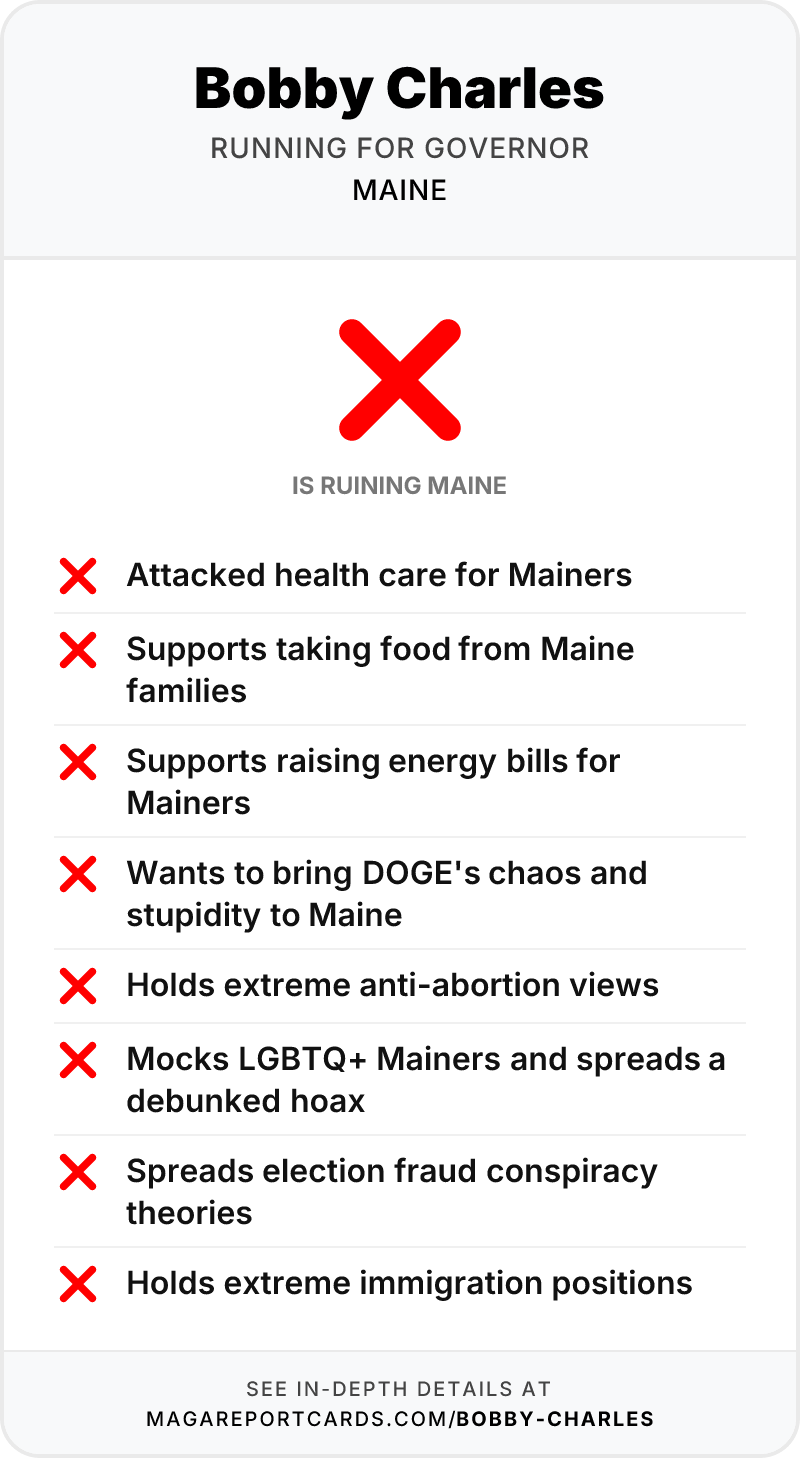
Charles ran a primary campaign heavy on social media and artificial intelligence, built around attacking his opponents. His rivals banded together against him, calling him out for skipping debates and for promises they called too lofty. At a May debate, five of them declined to say whether they would even support him if he became the nominee.
He became the nominee anyway.
The bottom line
Bobby Charles is asking Mainers to make him the person who enforces the state's laws. Along the way, his campaign was reported to the state's ethics commission over an anonymous website attacking a fellow Republican, and answered by swearing out an affidavit confirming it had built two other attack sites — just not that one.
The commission voted unanimously to go find out who paid. As far as we can tell, Maine voters still don't have the answer.
Mainers deserve a governor who doesn't need an ethics investigation to explain his campaign tactics. We deserve better.
Source
Emma Davis, "Ethics Commission to investigate website attacking gubernatorial candidate Ben Midgley" — Maine Morning Star, May 27, 2026. Image via Maine Morning Star (official campaign photos).