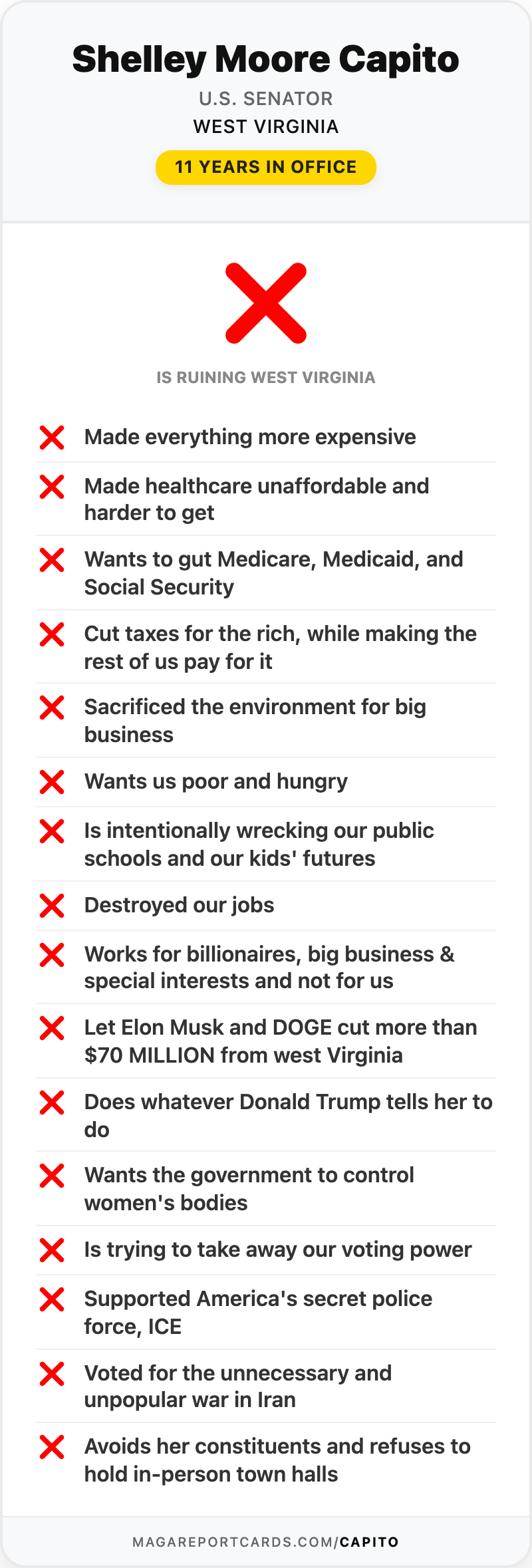
On October 7, 2025, the United States Senate confirmed a batch of Trump administration nominees, 51 to 47. Tucked into that list, among 107 names, was this one:
"Arch Capito, of West Virginia, to be United States Attorney for the Southern District of West Virginia for the term of four years"
Arch Capito goes by Moore. He is the son of Shelley Moore Capito, the senior senator from West Virginia.
She voted yes.
What she could have done instead
There is a word for what a senator does when a matter before them involves their own family. The word is recuse. You step aside. You don't cast a ballot on your own child's job.
Capito didn't step aside. She voted to confirm him.
To be precise about it, and precision matters here: her vote was not the one that put him over the top. The tally was 51–47. If she had abstained it would have been 50–47, and her son would have been confirmed anyway. Some outlets have described this as a deciding vote. It wasn't, and we're not going to say it was.
What it was is a choice. Faced with a vote on her own son's federal appointment, Capito had the option to sit it out and lose nothing. The outcome was never in doubt. Recusing would have cost her exactly zero and answered the question before anyone asked it.
She voted anyway.
She announced the nomination herself
This wasn't a case of a senator quietly finding her relative buried in an en bloc list.
On July 1, 2025, Capito publicly announced both of West Virginia's U.S. Attorney nominations — her son's included:
"Thrilled and extremely proud that @POTUS has chosen two stellar candidates to be West Virginia's U.S. Attorneys, Matt Harvey in the Northern District and Moore Capito in the Southern District. I look forward to supporting their quick confirmations so they can get to work on behalf of West Virginia."
Understand what it means that the announcement came from her.
U.S. Attorneys are federal prosecutors, and by long Senate custom a nomination for one doesn't move without the support of the home-state senators. The chairman of the Senate Judiciary Committee put it plainly six weeks before this vote: "there are not enough votes in the Senate to advance a district judge, U.S. Attorney or U.S. Marshal nominee who doesn't have a blue slip." That courtesy is real power. Cindy Hyde-Smith of Mississippi used the same custom in reverse to single-handedly kill a federal judicial nomination — no vote, no debate, just a slip of paper she declined to return.
Capito is one of West Virginia's two senators. Her son's nomination needed a senator like her not to object. She didn't object. She announced it, celebrated it, and then voted for it.
Who Moore Capito is
Moore Capito served in the West Virginia House of Delegates from 2016 to 2023 and ran for governor in 2024, losing the Republican primary. He practiced corporate and energy law before the appointment.
That is a normal résumé for a political appointee. Nothing about it is disqualifying. The question was never whether he's a plausible lawyer — it's whether a sitting senator gets to vote on her son's confirmation.
The office his grandfather knew
Here is the part that makes this more than an etiquette problem.
The U.S. Attorney's office for the Southern District of West Virginia — the office Moore Capito now runs — is the office that sent a West Virginia governor to federal prison. Michael Carey held that job from 1987 to 1993, and his team brought the charges. The target was Arch A. Moore Jr.: three-term governor of West Virginia, Moore Capito's grandfather, and Shelley Moore Capito's father.
In May 1990, Arch Moore pleaded guilty to five felonies — mail fraud, tax fraud, extortion, and obstruction of justice. He had taken illegal campaign money and kept it off his tax returns, and he had extorted $573,721 from a coal company in exchange for helping it obtain a $2.3 million refund from the state's black lung program. He was sentenced to five years and ten months in prison and fined $170,000.
Thirty-five years later, his grandson took over the office, with his daughter voting yes.
We're not saying the son is his grandfather. We're saying that of all the offices in the federal government, this is the one where a Capito ought to have understood, without needing it explained, why the appearance of the thing matters — and why a senator with the family name should have handed the vote to somebody else.
Why any of this matters to West Virginians
A U.S. Attorney is not a ceremonial job. That office decides who gets charged in the southern half of the state — public corruption, opioid trafficking, fraud against federal programs. It decides which powerful people get investigated and which don't.
West Virginia has an unusually direct stake in that. It is a state where public corruption has reached the governor's mansion and been prosecuted by this very office, within living memory, in a case that sent the sitting senator's father to federal prison.
The person who now makes those calls owes his job to a process his mother helped run and personally voted to complete. If his office ever has to decide whether to investigate someone connected to the state's Republican establishment — the establishment his mother sits atop as the fourth-ranking Republican in the Senate — every West Virginian is entitled to wonder whether that call was made on the merits.
That doubt is the cost. And it was completely avoidable. Capito could have released a one-sentence statement saying she was recusing from her son's confirmation vote out of respect for the office. Her son gets confirmed either way, and nobody writes this article.
Instead she voted, and now the question follows the office.
Sources
- Senate Roll Call Vote 547 — en bloc confirmations, October 7, 2025 (Capito: Yea; includes "Arch Capito, of West Virginia, to be United States Attorney for the Southern District of West Virginia")
- WV MetroNews: Senator Capito announces the nominations for U.S. attorney, including son Moore Capito (July 1, 2025)
- UPI: Corrupt ex-governor gets prison, fine (July 10, 1990)
- UPI: Former Gov. Arch Moore was indicted Thursday on five... (April 12, 1990)
- AP / Roanoke Times: ARCH MOORE GUILTY (May 8, 1990)
- Q&A: Blue Slips, U.S. Senator Chuck Grassley, chairman of the Senate Judiciary Committee (August 29, 2025)