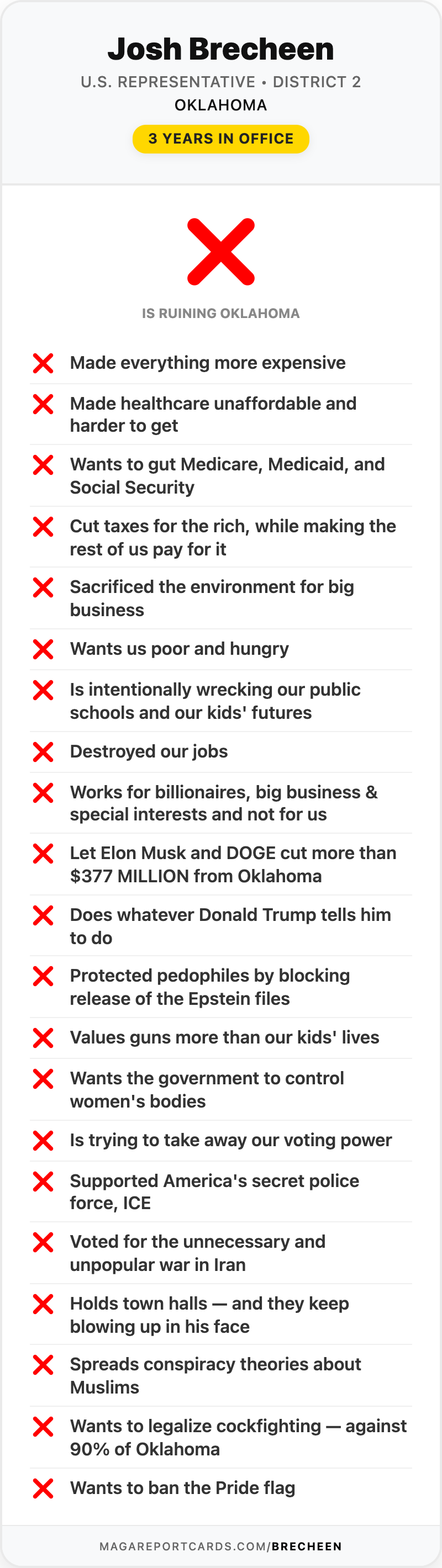
Josh Brecheen has built his whole political identity on one word: offsets. He doesn't vote for new spending unless somebody says where the money is coming from. He was an original cosponsor of the Make DOGE Permanent Act. He pushed the Senate to swallow the DOGE cuts without changing a comma — "It's an easy list. I don't understand the opposition."
On Monday, July 20, 2026, he drew a line. On Wednesday, July 22, he stepped over it.
Monday: the red line
House Republican leaders were assembling a fast-track budget package — a bill written to pass the Senate with a simple majority instead of the usual 60 votes — to pour billions into the Iran war and to push states toward requiring photo ID and proof of citizenship to vote.
Brecheen told The Washington Times he was out unless the package carried the real SAVE America Act — the actual mandate, not a watered-down version.
"I'm not willing to make that investment of deficit spending if they send us back garbage."
Speaker Mike Johnson had floated a compromise: a grant program that would pay states to adopt voter ID and proof-of-citizenship rules voluntarily. Brecheen was asked whether that would be good enough to earn his vote for unpaid-for military spending.
His answer was "not at all." He explained exactly why:
"The grant program is only going to be for states that want to do it. What do you get out of that?" he said. "The reality is, people in the Democrat-leaning states, they don't want to change the system. … Throwing some carrots at them will do nothing."
He wanted Senate Republicans to overrule the Senate parliamentarian — the chamber's referee on what can ride along on a fast-track bill — so the full mandate could pass with 51 votes. And he said that without the real SAVE America Act, he'd join the conservatives refusing to back new spending without offsets.
Clear enough. Two conditions: the real mandate, or the money gets paid for.
Wednesday: he got neither, and voted yes anyway
The budget blueprint the House took up on July 22 authorized up to $95 billion. Per The Washington Times' account of the vote, that broke down as up to $73 billion for Trump's Iran war request, up to $12 billion in farm aid, and up to $10 billion instructed to the House Administration Committee for the election requirements.
That $10 billion is the grant program. It is the carrots.
There were no offsets. That was the single loudest objection in the room — Rep. Warren Davidson of Ohio voted no over exactly that, and Rep. Thomas Massie of Kentucky called the defense money a "slush fund" for the war.
The resolution passed 216 to 214. Only two Republicans and one independent voted against it. The Clerk of the House records the roll call.
Brecheen voted Yea.
A two-vote margin means every single yes was decisive. His was one of them.
The best he could manage was a hope, delivered to the same paper he'd drawn the line to two days earlier:
"It better accomplish something. It can't be lipstick on the hog, and we're pretending it's something that it's not."
That is not a red line. That is a wish.
What changed in 48 hours
Not the bill. The bill contained the grant program he'd called worthless and the deficit spending he'd said he wouldn't make.
What changed was the pressure. Trump warned that he was "watching the vote very closely." Vice President JD Vance worked the phones personally, calling members to reassure them the White House was serious about the full SAVE America Act later — not the optional version actually written into the blueprint. The Daily Signal, a conservative outlet, reported that Vance's calls are how skeptical conservatives were brought on board.
So the promise Brecheen accepted, in exchange for voting for a bill he'd said was garbage, was a phone call about what might be in a future bill.
The same afternoon, on the same floor
Here is the part that makes this more than an ordinary flip.
Twenty minutes before the budget vote, the House passed the annual defense authorization bill. Brecheen voted no on that one — one of seven Republicans to do it, breaking with his own leadership and with every other member of Oklahoma's delegation, in a 216-212 squeaker that only cleared because six Democrats crossed over.
He put out a statement the same day explaining himself, which News On 6 published in full:
"While I support providing for a robust national defense, I could not in good conscience vote for this legislation as it authorizes a $263.4 billion (29.6%) increase over the authorized level for the previous fiscal year. … We are currently facing the largest national debt in our country's history, owing over $39.5 trillion, and we simply cannot bear the cost of additional, unpaid-for spending."
He has an argument for why the two votes aren't identical, and it deserves a fair hearing: the defense bill raises the annual baseline forever, while the fast-track package is a one-time expenditure. He said so in the same statement.
But read the next sentence of it. His own proposed fix was that "in the current Reconciliation 3.0 or in a future reconciliation package," Congress should "find meaningful offsets."
Reconciliation 3.0 is the blueprint he voted for twenty minutes later. It has no offsets in it.
At 4:37 in the afternoon he could not in good conscience vote for unpaid-for spending. At 4:57 he authorized up to $95 billion of it.
Who this actually costs
Oklahoma's 2nd District is not a wealthy place, and Brecheen's own voting record has already taken a lot out of it.
An estimated 41,415 people in OK-02 are projected to lose health insurance from the Republican cuts to Medicaid and the Affordable Care Act in last year's budget law — 23,615 of them off Medicaid, the other 17,800 off ACA coverage. That is the largest projected loss of any Oklahoma district. His district also leans on food assistance more than any other in the state: 55,436 households, 17.6% of every household in the district, including 26,140 households with children.
Those cuts were sold as fiscal discipline. The offsets were the whole justification.
Then $95 billion in war and farm money showed up with no offsets at all, and the man who cosponsored the bill to make DOGE permanent voted for it in exchange for a promise.
And the thing he traded it for
Don't lose track of what the $10 billion is actually for. It is public money spent to push states to make voting harder — proof-of-citizenship paperwork to register, photo ID at the polls. We've written about what that paperwork does to real people: the SAVE Act leans on birth certificates and passports as proof, and as many as 69 million American women don't have a birth certificate with their current married name on it. About half of Americans don't have a passport at all.
Brecheen's objection to the grant program was never that it made voting harder. It was that it wouldn't make voting harder in blue states. His complaint, in his own words, was that "people in the Democrat-leaning states, they don't want to change the system."
He wanted a federal mandate to force them. He settled for $10 billion in carrots, plus a phone call.
Brecheen has represented OK-02 since 2023. He won his Republican primary on June 16, 2026 and is on the ballot again in November.
We deserve better.
Source
George Caldwell, "House Republican draws red line; won't back Iran war supplemental without SAVE America Act or offset", The Washington Times, July 20, 2026, and Lindsey McPherson's July 22 report on the vote. Brecheen's NDAA statement via Alex Cameron, News On 6. Roll call data from the Office of the Clerk of the House. (Photo: AP Photo/Rebecca Slezak, via The Washington Times)