Before he went to Congress, Tom Barrett spent eight years in the Michigan Legislature. In 2019 he ran the state Senate subcommittee that writes the corrections budget — the bill that decides, among other things, how much money county jails get back from the state for holding state prisoners.
He used it to go after counties that would not do ICE's work for them.
What the budget language did
In May 2019, Barrett put language in the Senate corrections budget that would withhold jail reimbursement money from any county that adopted or enforced a policy limiting communication or cooperation with federal immigration officials.
This was not a fine or a warning. It was a funding cutoff, aimed at county sheriffs, written into the state budget by the senator who chaired the subcommittee.
The counties that stood to lose money, and what they got each year:
- Wayne County — about $1.5 million
- Kent County — about $1.1 million
- Kalamazoo County — about $975,000
- Washtenaw County — about $520,000
Barrett defended it plainly. "I think this is good to require, good to maintain, and I think it should be expected" of law enforcement to work cooperatively, he said.
What those counties had actually done
The policies Barrett was punishing were not refusals to enforce the law. They were decisions about how long a county can hold someone it has no charge against.
An ICE detainer is a request, not a warrant. It asks a jail to keep someone locked up past the point where they would otherwise walk out, so federal agents have time to come get them. Several Michigan counties — including Ingham County, which contains Lansing and sits in the congressional district Barrett represents today — had decided they would not hold people past their booking period on a detainer alone, without a judge's warrant.
There is a reason sheriffs want a warrant first. A detainer is issued by an ICE agent, not a judge, and numerous courts have found that a county which holds someone past their release date on a detainer alone is violating the Fourth Amendment and can be made to pay damages — a federal judge so ruled against Clackamas County, Oregon. A sheriff asking for a warrant is following legal advice, not defying federal law. Barrett's budget would have taken money out of those counties' jails anyway.
Michigan's own corrections department said it wouldn't work
The opposition did not come only from Democrats. The Michigan Department of Corrections opposed the language, warning that it would hit cases that had nothing to do with immigration at all and could push more people into state prisons, at greater cost to the state.
Sen. Adam Hollier, a Detroit Democrat, called it what it was: "The majority is trying to make all of these things into political issues, and make national political issues local issues, and I just don't think that's appropriate in this space."
Barrett said at the time that he had not heard concerns from the Department of Corrections and was not sure how much the penalty would actually cost the counties involved. He was proposing to cut millions from county jails without knowing what it would do to them.
The provision did not survive. Governor Gretchen Whitmer line-item vetoed the anti-sanctuary language out of the budget later that year.
He represents one of those counties now
Ingham County is the center of Michigan's 7th District. Barrett's own Lansing office is in it. In 2019 he wrote a budget that would have taken jail money away from it over a policy its own sheriff had adopted.
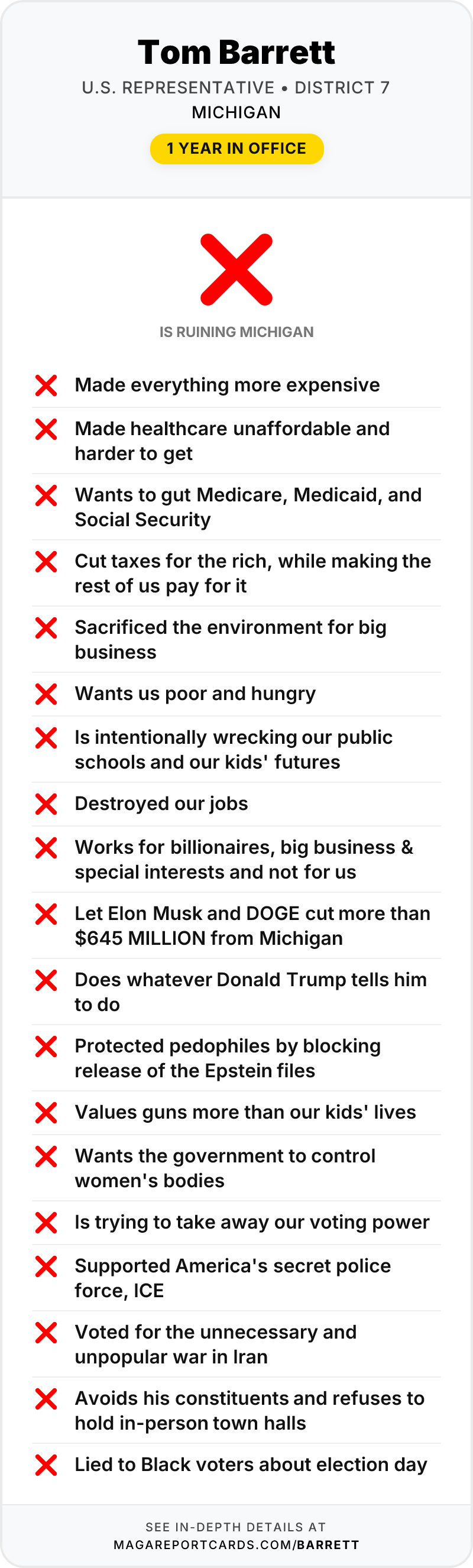
He has not made that easy to ask him about. Barrett has refused to hold an in-person town hall in mid-Michigan. He holds telephone town halls instead, and he started doing it on guidance from the House Republicans' campaign arm to avoid backlash at in-person meetings. In March 2025, constituents delivered more than 2,000 petition signatures to that Lansing office asking for a real one. In April, the AFL-CIO and the NAACP held a 7th District town hall without him.
In Congress he has kept going the same direction. Barrett voted for Trump's budget bill in May 2025 — the law that put $45 billion into expanding immigration detention, more than the government spent on housing migrants under the Obama, Biden and first Trump administrations combined, plus billions more to pay state and local governments to help.
What the record shows
In 2019, as chair of Michigan's Senate corrections budget subcommittee, Tom Barrett wrote language that would have stripped jail reimbursement funding from any county limiting cooperation with ICE — about $1.5 million a year from Wayne County, $1.1 million from Kent, $975,000 from Kalamazoo and $520,000 from Washtenaw. Michigan's own Department of Corrections opposed it, warning it would hit unrelated cases and cost the state more. Barrett acknowledged he did not know what the penalty would cost the counties. The governor vetoed it. One of the counties whose policy he was targeting was Ingham, the seat of the district he now represents in Congress, where he has refused to hold an in-person town hall.
Source
"Barrett Wanted to Punish the Jails That Stopped Holding People for ICE," by Pablo Manríquez, Migrant Insider, September 8, 2026. The 2019 budget language and the counties' funding figures were confirmed against Jonathan Oosting's contemporaneous reporting for The Detroit News, May 1, 2019, republished in full by Police1.