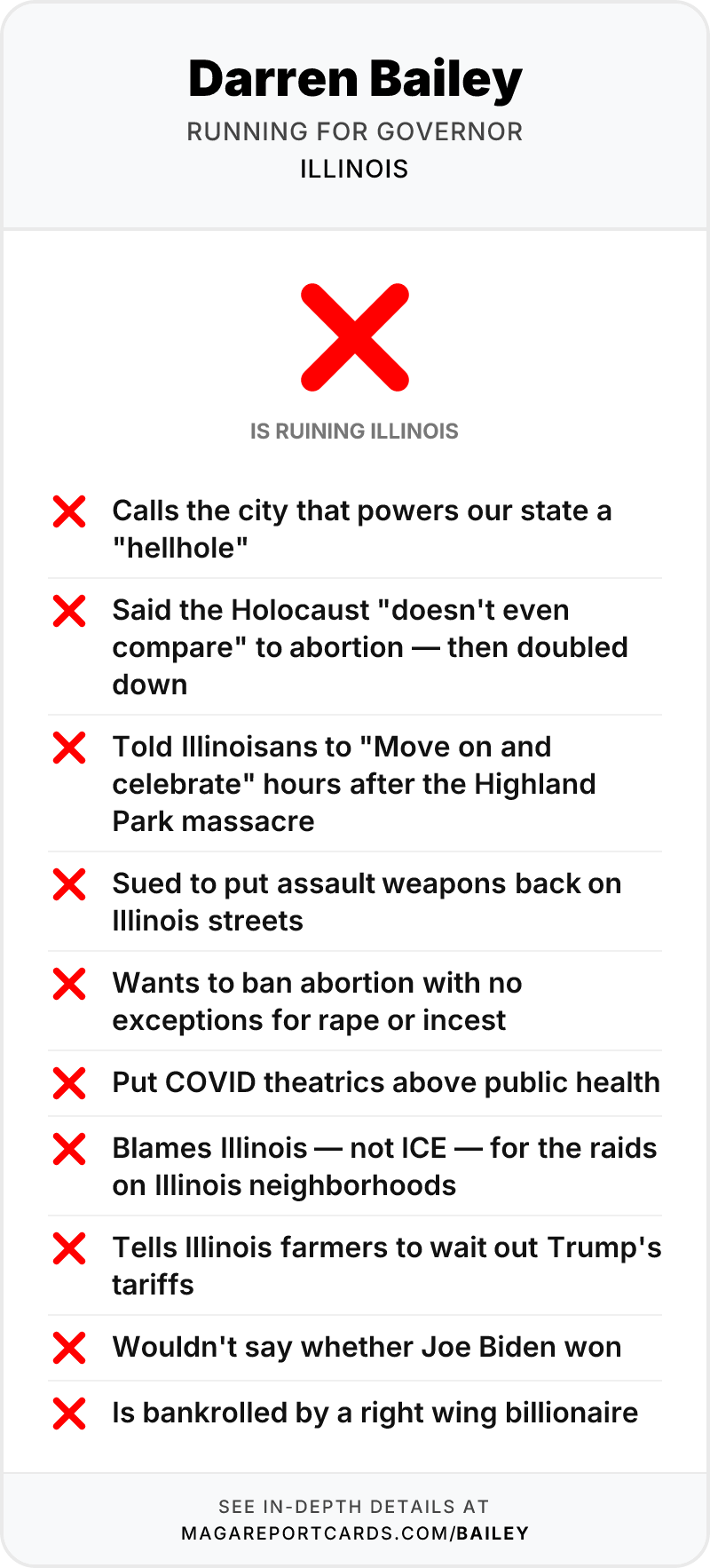
Darren Bailey wants to be governor of Illinois, and his campaign website tells you exactly what he thinks the job is. He is "committed to restoring law and order and making our neighborhoods safe again." He will "hold violent criminals accountable, crack down on repeat offenders, and stop policies that put politics ahead of public safety." And the closer: "Every family in Illinois deserves to feel safe in their homes, schools, and communities—and Darren Bailey will make sure they do."
On August 17, the Chicago Sun-Times reported who has been helping pay for that message.
The Donor
Victor D. Barr is a Rockford man who was convicted of aggravated criminal sexual abuse in the early 2000s. The victim was a girl who attended the public high school where Barr taught math.
He was required to register as a sex offender — his name, photo and address posted on a publicly accessible Illinois State Police database for the rest of his life. Not for five years. Not for ten. For life. That database is free, searchable by anyone with a web browser, and it exists precisely so that people can look someone up.
Barr is now a pastor at Rockford Faith Center.
Barr and his household have given money to Bailey's campaigns three separate times:
- $2,000 in 2022, about a month before that year's election
- $700 in April 2026
- $400 in June 2026
That is $3,100 across two campaigns and four years, all of it recorded in the Illinois State Board of Elections database that every campaign in the state is required to file with.
And Then He Showed Up in Person
This is the part that makes "we didn't know" hard to hold onto.
In June 2026 — the same month as the $400 donation — Bailey attended a service at Rockford Faith Center, the church where Barr serves as pastor. The church posted about it on Facebook afterward: "Pastor Marla had the opportunity to pray over Darren Bailey and his wife."
So the sequence is a donation in April, a visit to the church in June, and another donation in June. A candidate for governor did not merely cash a check from a stranger. He went to the man's church.
The Response Came After the Phone Call
Bailey's campaign told the Sun-Times: "We did not know his background. ... We're going to find a charity and donate it. ... We're committed to making it right."
Notice what triggered that. Not an internal review. Not a staffer running the routine check that any campaign can run for free on a state database. A reporter called.
The campaign's explanation for the church visit was that Bailey goes to a lot of churches — that "we go to African American churches, major Protestant, nondenominational churches. ... He goes everywhere."
That may well be true. It is also not an answer to the question. The question is why a campaign that promises to "crack down on repeat offenders" never once, in four years and three donations, looked up a donor whose name sits on a public sex offender registry.
This Is Not the Only Time
The week before the Sun-Times story ran, Bailey spoke at the Signs & Wonders Christian conference in Rochelle, held August 9-12. LGBTQ Nation reported that he shared the bill with Richard Jones, a registered child sex offender who was charged with two counts of sexual assault against 15-year-old male victims in 1990 and 1997, according to the Missouri State Highway Patrol. In 1997 a court sentenced Jones to six years in prison.
Jones' website now describes his walk away "from sexual addiction and homosexuality," and says he "conducts ministry and teaches principles that redeem and restore those struggling in addictive bondage."
Two different men. Two different states. Two different sets of charges involving teenagers. One candidate for governor, standing next to both of them inside the space of a few months.
At some point "we did not know his background" stops being an explanation and starts being a description of how the operation runs.
The Part That Should Sting
Here is the detail that turns this from an embarrassing story into a genuinely ugly one.
Bailey runs a Christian private school. Its curriculum, per that same LGBTQ Nation report, states that "Gay people have no more claims to special rights than child molesters and rapists."
Sit with that. The school Bailey runs teaches children that gay people are comparable to child molesters — while Bailey himself takes money from a man convicted of sexually abusing his own student, and shares a conference stage with a man convicted of sexually assaulting teenage boys.
The comparison was never a moral standard. It was a weapon, and it was only ever pointed one direction.
A Pattern of Saying It Wasn't What It Looked Like
Illinoisans have seen this move from Bailey before. It follows a shape:
- He compared abortion to the Holocaust, then, when Jewish groups objected, said Jewish leaders had told him he was right — and they said that wasn't true.
- He took abortion off his campaign platform, then stood at an anti-abortion rally while his running mate called it a "sin against God."
- Ninety minutes after the Highland Park massacre he told Illinoisans to "move on and celebrate" — then sued six months later to undo the gun law it produced.
Every time, the pattern is the same. Do the thing. Get caught. Explain that it wasn't really the thing.
What This Actually Costs Us
Illinois families are not asking for much here. They are asking that the person who wants to run the state's police, prisons, and child protection systems be able to do the single easiest safety check there is — typing a donor's name into a public database that the state built and maintains.
Bailey's whole pitch is that he is the one who takes public safety seriously and his opponents put "politics ahead of public safety." But when checking a donor might have cost him $3,100, nobody checked. The donations stood on the public record through two election cycles. It only became a problem when it became a headline.
A candidate who promises to protect your kids should be able to notice who is writing his checks.
Source
- Darren Bailey took campaign money from sex offender who's now a pastor, went to service at his church — Chicago Sun-Times, The Watchdogs, August 17, 2026.